
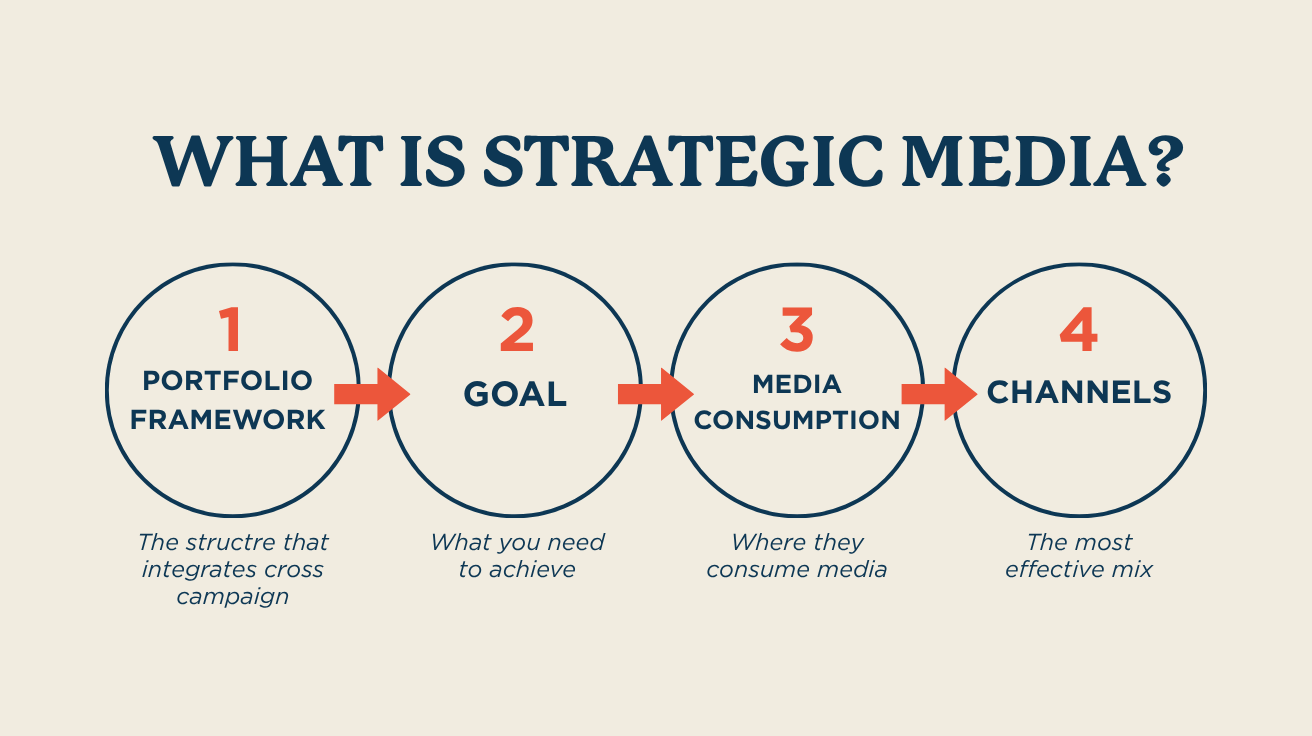
Strategic Media = Actionable Plan
Strategic media is the disciplined process of connecting your business goals and ideal customer profiles to the media channels, creative, targeting, and measurement that serve them.
It produces one thing: an actionable plan where every channel earns its place by contributing to a defined outcome.
This question comes up often, so we want to answer it clearly. Strategic media is the difference between buying placements and building an accountable advertising portfolio.
The Short Answer
Most advertising gets bought channel by channel. A placement here, a campaign there, each evaluated on its own numbers.
Strategic media works in the opposite direction. You settle the business goal first, then let that goal govern every decision that follows.
The channels, the targeting, the creative, and the way you measure success all inherit their meaning from that goal. When the order holds, advertising behaves like a managed portfolio. Each holding is judged by what it adds to the whole.
Why the Order Matters
We have sat with organizations whose stated ambition pointed one direction while their campaign setup pointed another. The channels were fine. The creative was fine. The goal was never truly agreed on.
That gap is where good money underperforms.
The most common mistake in media planning is choosing tactics before the goal is settled. Catching that mismatch before anything goes live protects both the budget and the relationship.
So the discipline lives in one rule: no downstream choice gets made or measured out of order.
How We Build a Strategic Media Plan
Our method follows the dependencies. Settle the destination, gather evidence about the terrain, then match resources to the route.
Here are the steps in order.
Step 1: Define the Campaign Structure and Goals
Everything begins here. In the older adult market, a single decision often involves several people at once: older adults, senior family influencers, and at times, caregivers and healthcare professionals. Each audience will require different campaign goals, channels, and creative. Setting the campaign structure across the entire media portfolio is the first step to ensure a cohesive portfolio strategy that works together. At the same time, we define what the campaign is meant to achieve before we discuss a single channel.
Goals fall into recognizable categories:
- Brand awareness
- Demand generation
- Lead generation
- Consideration
- Engagement
- Conversion
The goal sets the definition of success and also ladders up to business goals. It also sets the yardstick we use later, which keeps us from grading one kind of effort with a metric built for a different kind.
Step 2: Research the Audience
Next we study how the target audience actually consumes media.
Market research tells us where attention concentrates by channel. In the older adult market this matters more than usual, because a single decision often involves several people at once: older adults, senior family influencers, and at times, caregivers and healthcare professionals.
Each group carries different media habits. The research identifies which channels are genuinely available for reaching them.
Step 3: Match Resources to Channels
Now we weigh three inputs against the available channels:
- The campaign goal from Step 1
- The available budget
- The available creative
This is where the channel mix takes shape. We choose the combination that serves the goal within the resources at hand.
How the Mix Changes With the Goal
The same audience calls for different channels depending on what the campaign needs to accomplish. Two examples make this concrete.
The demographics overlap. The channel decisions do not. That is the goal doing its job.
Connecting Channels to the Funnel
Strategic media evaluates how each channel contributes across the full journey:
- Awareness
- Demand generation
- Lead generation
- Conversion
- Revenue
Every channel gets tied to a stage. That linkage is what makes the portfolio accountable. You can see what each dollar is meant to do and check whether it did it.
One honest note on measurement. We do not promise precise attribution where it cannot exist. Upper-funnel awareness rarely offers clean click-to-revenue tracking. We match the benchmark to the goal rather than forcing every campaign to use the same measurement. Grading an awareness campaign by conversion metrics tells you the wrong story.
Why This Approach Holds Up
Strategic media replaces speculative spending with evidence and structure. It gives you a plan you can defend inside your organization, because each decision traces back to a business goal.
The media landscape continues to fragment across traditional and digital channels. A disciplined framework becomes more valuable as the choices multiply. Organizations that treat advertising as a managed investment can show the value of their spend. Those working from isolated buys often struggle to explain what worked.
The Takeaway
Would you build a house without architectural drawings? Then why would you start investing in paid media without your own blueprint?
Strategic media is the discipline of letting the business goal govern every downstream choice and measure. Be intentional about what you are trying to achieve before a single dollar moves.
Settle the goal. Study the audience. Match resources to channels. Measure each channel against the job you gave it.
Done in that order, your advertising stops being a series of placements and starts working as an accountable portfolio. That is the shift we help marketing leaders make and it starts with the decision to be intentional from the beginning.
Read about our full media services approach here.
Author: Suzanne Corriell, CEO | Founder