
Your Advertising Is Competing for a Small Slice of the Market. Here Is the Larger One You Are Missing.
This article draws on insights from James Hurman’s keynote presentation and book, Future Demand. Hurman is a New Zealand-based advertising effectiveness expert, entrepreneur, and investor. His research is built on some of the largest advertising effectiveness databases ever assembled. We are sharing his findings here because they align with what we see in practice and because we believe more marketing leaders need to hear them.
A Simple Question That Changes Everything
James Hurman opens his Future Demand keynote with a thought experiment. Imagine a room of a few hundred marketing and agency executives. He asks: how many plan to buy a new phone this month? A handful of hands go up. Then he asks: how many plan to buy one in the next 6 to 12 months? Most of the room raises a hand.
That moment, Hurman argues, holds the most expensive misunderstanding in marketing today.
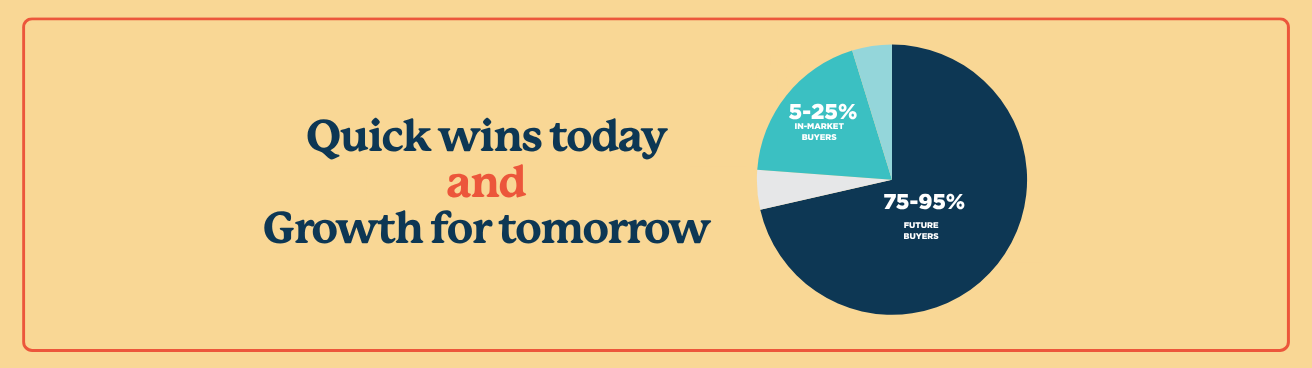
The buyers ready to act right now represent 5 to 25 percent of the market opportunity at any given time. The far larger group, those who will buy later, represents 75 to 95 percent. Most advertising budgets concentrate on the smaller slice, while the larger opportunity receives almost no investment at all.
The Performance Marketing Trap
Hurman is careful not to dismiss performance marketing. Both performance and brand marketing are powerful, he says, and they are more powerful when used together. The issue is the imbalance between them.
Performance marketing does one thing well: it captures demand that already exists. It finds the buyers who are in the market right now and competes for their attention at the point of decision. When investment is optimized almost entirely for people already raising their hands, it competes for a fraction of total demand while the rest of the category forms its preferences without that brand present.
The data is clear on this. According to the Pulse of Performance Advertising, 75 percent of marketers are already experiencing diminishing returns on their performance marketing spend. The 2026 Marketing Priorities Report found that marketers’ biggest regret was over-indexing on short-term tactics at the expense of long-term brand building.
The 84% Finding That Should Reframe Your Budget
The most striking data point Hurman cites comes from Oxford University and WPP Media, who analyzed 1.2 million purchase journeys across 200 categories in 47 countries. They found that 84 percent of purchases are made by people who already carry a brand preference before they enter the active shopping stage. That bias holds consistently across all categories, from smartphones to sneakers to air travel to beer.
Kantar’s BrandZ tracking adds a financial dimension. Companies that balance brand building with performance investment dramatically outpace their S&P 500 peers in value and market size over time.
Hurman’s conclusion from all of this is worth quoting directly: advertising doesn’t cause sales. It ensures brands win a greater share of them. When you make people familiar with your brand in an emotionally positive way before they enter the category, you make them more biased to act on your marketing and more willing to pay a premium when they do.
What This Means in Practice
At Growth Marketing Werks, Hurman’s framework resonates because it aligns with our media portfolio approach. We build full-funnel frameworks that integrate across an organization’s products, services, and channels rather than operating in isolation. The brands that grow durably are the ones that fund both performance and brand building with intention.
We approach media the way a financial advisor approaches a portfolio. There is the near-term position that drives performance now, and the long-term position that compounds over time. Each has a distinct role. Each requires its own measure of success. Funding only the near-term position is a choice, and it carries a real cost that shows up later.
Giving This Conversation to the CFO
One of Hurman’s most practical contributions is about language. The barrier to a more balanced mix is often not belief. Marketing leaders already understand the case for brand investment. The more common barrier is the conversation upstairs, where advertising has long been treated as a capital expenditure rather than an investment in market share growth and profit margin resilience.
Hurman’s effectiveness framework offers language that finance leaders understand and respect:
- Share of Voice drives Market Share. If you invest more in share of voice, how much more market share can you expect to grow?
- Underfunding brand has a growth cost. If you continue to underspend on brand, what will it cost you over the short, medium, and long term?
- Priming bias is measurable and consistent. Across all categories, 84 percent of purchases are made with a priming bias already in place, and strong creative increases that bias.
This is the same discipline a CFO applies to any capital allocation decision: weigh the return, account for the cost of inaction, and rebalance toward sustainable growth.
Where to Start
A full strategy overhaul is not where to begin. Start with a clear audit of where your budget actually sits.
- Map your current split. How much of your budget captures existing demand versus building future demand? Most teams find the answer is more lopsided than they assumed.
- Match the metric to the objective. Short-term sales are the wrong measure for investment meant to compound. Check that your measures fit what each part of the budget is meant to do.
- Model the cost of the gap. Quantify what continued underinvestment in brand costs you over the next one, three, and five years. Make the invisible price visible.
The data Hurman presents is consistent across countries, categories, and sources. Markets work the same way. Buyers form preferences before they arrive. Allocating against that reality with intention, rather than defaulting to a small slice of current demand, is where durable growth begins.
If you want a clear read on where your spend sits today and what a more balanced mix would return, that is the conversation we are built for.
To go deeper on James Hurman’s research, visit futuredemand.com or look for his book, Future Demand, wherever books are sold.
Author: Suzanne Corriell, CEO | Founder