
Introduction
Buyers rarely convert after a single touchpoint. Research from McKinsey shows that business customers now use an average of 10 interaction channels during the buying journey, double the five channels typical in 2016. Consumer behavior has followed a similar trajectory.
The result: brands running disconnected channel strategies are losing ground to competitors who can deliver a consistent, connected experience across every touchpoint.
This guide identifies the top omnichannel media agencies for 2026, what separates genuine integrators from agencies that simply bundle services, how to evaluate them on criteria that actually drive outcomes, and which fits your organization's size, sector, and goals.
Key Takeaways
- True omnichannel means shared data, unified strategy, and cross-channel reporting, not just a broad service menu
- Campaigns using three or more connected channels earn a 494% higher order rate than single-channel campaigns
- Flat-fee pricing aligns agency incentives with your growth; commission-based models don't
- Industry specialization matters, as generalist agencies carry a costly learning curve
- For organizations serving the older adult market, a flat-fee advisory model, like the one Growth Marketing Werks uses, removes the conflict of interest that commission-based buying creates
What Is Omnichannel Marketing and Why It Matters in 2026
Omnichannel vs. Multichannel: A Critical Distinction
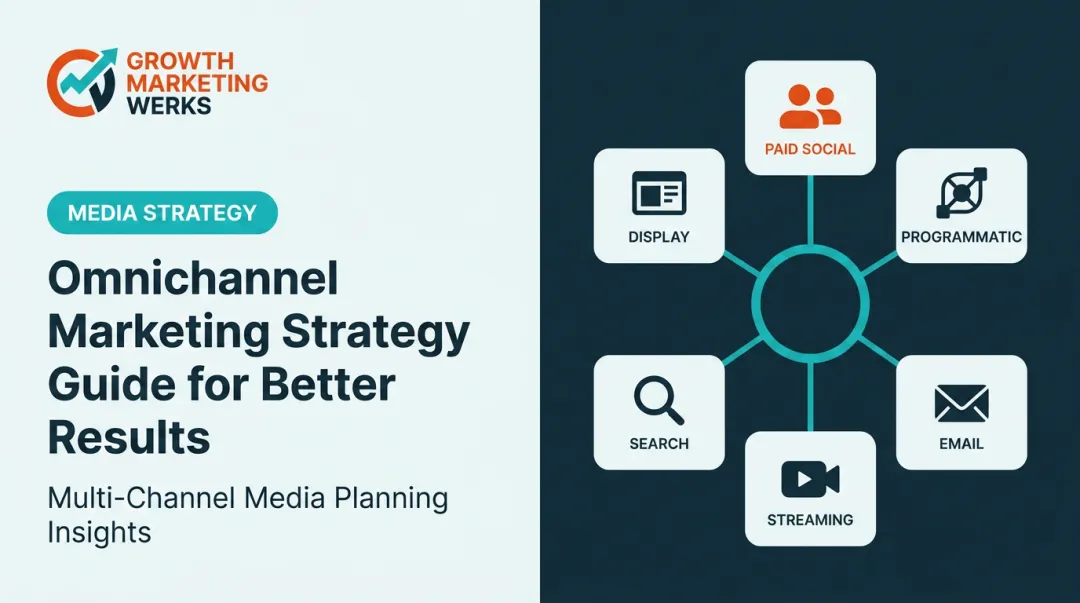
Omnichannel marketing means every channel a brand uses, including paid, owned, and earned, shares data so each touchpoint informs the next. A prospect who clicks a LinkedIn ad encounters consistent messaging when they later search on Google, see a display ad, or open an email. The experience feels continuous because connected data ties each touchpoint together.
Multichannel marketing is different. A brand can be present on six platforms and still operate in complete silos, with separate agencies or teams, separate reporting, no shared audience data, and no unified strategy. In 2026, that fragmentation costs pipeline.
The data is hard to ignore:
- 494% higher order rate for campaigns using three or more connected channels versus single-channel campaigns, according to Omnisend's 2026 research
- 86% of business purchases stall during the buying process, per Forrester's 2024 State of Business Buying report, and fragmented marketing accelerates that stall
- Business ecommerce now accounts for 34% of revenue for organizations that offer it, while in-person-only sales continue to decline

What True Integration Looks Like in Practice
Those numbers reflect a structural problem, not a spending problem. Closing the gap means building three things most multichannel programs lack:
- Audience behavior on one channel actively shapes targeting and messaging on every other, not siloed by platform
- A single attribution framework ties all channels to pipeline and revenue, replacing disconnected platform reports
- Messaging evolves as a prospect moves through the funnel rather than repeating or contradicting across channels
Top Omnichannel Media Agencies for 2026
These agencies were selected based on cross-channel integration depth, data and attribution capabilities, pricing model transparency, industry experience, and verifiable client outcomes, not agency size alone.
Growth Marketing Werks
Founded and led by strategy-first media expert Suzanne Corriell since 2001, Growth Marketing Werks operates as a media advisory firm, not a traditional agency. Where conventional agencies take direction and execute, Growth Marketing Werks functions more like a financial planner for advertising dollars: building diversified media portfolios, managing cross-channel allocation, and optimizing toward revenue outcomes rather than impressions.
The agency specializes in full-funnel omnichannel media planning and buying for AgeTech, CPG, nonprofit, and government organizations serving the older adult market. Its flat-fee pricing model removes the conflict of interest inherent in commission-based structures: the agency earns the same fee regardless of how much media investment it recommends, so its only incentive is client growth.
Platform expertise is entirely in-house, with certified team members across The Trade Desk, Google Campaign Manager, and Meta. Datorama serves as the data aggregation and visualization backbone, connecting performance data across all active channels into unified reporting clients can act on.
The agency's five-stage campaign process (strategy, media planning and negotiation, creative preparation and trafficking, active optimization, and reconciliation and reporting) provides operational structure that most boutique firms lack.
Verified client results include a +179% increase in ARR bookings and +141% SQL growth for TalentReef, a -47% reduction in cost per lead and +177% lead volume increase for Trimble, and a +70% year-over-year increase in unaided brand awareness for Pinnacol Assurance.

The agency has earned multiple Fourteener Awards from The Marketing Alliance, including Gold in Lead Generation, Brand, and Paid/Owned/Earned categories. Team members have also been recognized as Best Media Buyer by Ad Club Colorado.
| Category | Details |
|---|---|
| Key Services | Full-funnel omnichannel media planning and buying; programmatic advertising; paid social; CTV/streaming; SEM; ABM; data attribution and reporting via Datorama |
| Pricing Model | Flat-fee, no commission tied to media investment; incentives aligned to client growth outcomes |
| Best For | AgeTech, CPG, nonprofit, and government organizations serving the older adult market, and brands seeking a strategic advisory relationship with white glove service |
WebFX
WebFX is a performance-focused digital marketing agency with a strong data infrastructure emphasis. Its proprietary platform, RevenueCloudFX, provides closed-loop ROI reporting by integrating with CRMs including Salesforce, HubSpot, and Nutshell, connecting sales and marketing data to identify which channels actually drive revenue. For businesses that need detailed cross-channel reporting alongside campaign execution, that attribution depth sets it apart from most performance agencies.
The agency claims to have generated more than $10 billion in revenue for clients and reports a 20% higher ROI across digital marketing channels. Published client examples include a 450% increase in SEO revenue for an interior furnishings client and a 261% increase in SEO leads for a manufacturing company.
Digital marketing packages start at $3,000 per month, with custom pricing depending on scope. The agency has 750+ team members, making it one of the larger performance agencies on this list.
| Category | Details |
|---|---|
| Key Services | SEO, PPC, paid social, email and SMS marketing, marketing automation, web design, RevenueCloudFX analytics |
| Pricing Model | Starting at $3,000/month for digital marketing packages; custom pricing by scope |
| Best For | Mid-market businesses wanting structured digital marketing programs with robust analytics and cross-channel attribution |
Hawke Media
Hawke Media positions itself as an outsourced CMO, offering fully a la carte omnichannel services without requiring long-term bundled contracts. Brands can start with one or two channels and expand over time as needs evolve, which works well for growth-stage companies that aren't ready for a full-service commitment.
The agency has helped scale 6,000+ brands and claims to have generated more than $2.9 billion in revenue for clients. Its proprietary Hawke AI analytics platform provides audience and competitive insights to inform cross-channel decisions. Published case results include a 1,082% ecommerce revenue increase for Barstool Sports and 485% return on ad spend (ROAS) for K-Swiss. The agency holds 12 Stevie Awards and five Inc. 5000 rankings.
Pricing is a la carte and varies by service and scope; specific rates are provided through a consultation process.
| Category | Details |
|---|---|
| Key Services | Performance marketing, paid media, email marketing, SEO, social media management, influencer marketing, content |
| Pricing Model | A la carte monthly retainer; pricing varies by service and scope |
| Best For | eCommerce, DTC, and growth-stage brands wanting flexible, performance-driven omnichannel support without a full-service contract |
Intelligent Demand (Now Part of 2X)
Intelligent Demand was acquired by 2X in December 2024 and now operates within 2X's Marketing as a Service (MaaS) model, a subscription-based structure designed for enterprise organizations that need to scale go-to-market programs without traditional agency overhead.
The combined entity specializes in ABM strategy, demand generation, revenue operations, and full-funnel go-to-market execution. It brings deep integration with platforms including 6sense, Salesforce, Adobe Marketo Engage, HubSpot, and Demandbase, with 175+ 6sense-certified professionals on staff. Self-reported performance claims include a 60% lower cost per engaged account and activation time reduced from 91 days to 7–14 days. The combined company has been recognized as one of the fastest-growing firms in the US by Inc. and the Financial Times.
Specific pricing is not publicly disclosed; engagement structure follows a subscription/MaaS model.
| Category | Details |
|---|---|
| Key Services | ABM strategy, demand generation, content marketing, marketing automation, CRM integration, revenue operations, AI-powered execution |
| Pricing Model | Subscription-based MaaS model; pricing by consultation |
| Best For | Technology companies, SaaS brands, and enterprises with complex sales cycles needing aligned sales and marketing programs |
Thrive Agency
Thrive Internet Marketing Agency is a full-service digital marketing firm founded in 2005, now operating with 160+ employees across 22 states. Its breadth of service (SEO, PPC, social media, email, content, and web design) makes it accessible for businesses seeking a single partner to manage multiple digital channels under one engagement.
The agency reports a 95% client retention rate and a full-funnel campaign result of 23x ROAS and $350K+ in ad revenue within six months. It holds 150+ Google reviews and 100+ Clutch reviews. Industries served include eCommerce, enterprise software, healthcare, manufacturing, and finance.
Thrive doesn't publish fixed pricing; it uses a custom proposal model. Its contact form suggests a minimum engagement range starting around $2,500/month.
| Category | Details |
|---|---|
| Key Services | SEO, PPC, social media marketing, email marketing, content marketing, web design and development |
| Pricing Model | Custom retainer; proposal-based engagement |
| Best For | Small to mid-size businesses across diverse industries looking for a full-service digital marketing partner |
How We Chose These Agencies
The evaluation prioritized three factors that affect outcomes, not optics.
1. Shared data infrastructure, not service bundling. Does the agency connect all channels through unified reporting, or just manage them separately? An agency that runs your SEO, PPC, and social independently with no unified reporting isn't omnichannel. It's multichannel bundling with a different label.
2. Incentives that point toward your growth, not their revenue. Does the agency's compensation structure align with your growth, or with its own revenue? Commission-based agencies earn more when you spend more, a structural incentive to recommend higher budgets regardless of efficiency. Flat-fee models eliminate that conflict.
3. Proven results in a vertical close to yours. Has the agency demonstrated outcomes in a vertical similar to yours? Generalist agencies carry a ramp-up cost, learning your buyers' language, regulatory environment, and decision-making patterns that a specialist has already internalized.

Two common mistakes to avoid when selecting an agency:
- Choosing on channel breadth alone, without asking how those channels share data
- Skipping the pricing model conversation, and asking directly how the agency earns when your budget grows
Conclusion
Omnichannel success in 2026 comes down to integration quality, not channel count. The agencies that drive results treat every channel as part of a coordinated growth system, sharing data, unified strategy, and consistent messaging, rather than a collection of a media portfolio managed under the same contract.
Before signing with any agency, pressure-test three questions:
- Does their pricing model align with your outcomes, or with their revenue?
- Can they show verifiable cross-channel results in an industry similar to yours?
- Do they have the data infrastructure to connect performance across channels into reporting you can actually act on?
For AgeTech, CPG, nonprofit, and government organizations serving the older adult market looking for a strategic media partner, Growth Marketing Werks operates on a flat-fee model with no commission tied to media investment, which means every recommendation is driven by your outcomes, not their margin. Reach out at info@growthmarketingwerks.com to start the conversation.
Frequently Asked Questions
What is the 3-3-3 rule in marketing?
The 3-3-3 rule is a messaging framework, though definitions vary. The most widely cited version suggests marketers have 3 seconds to capture attention, 3 minutes to build meaningful engagement, and 3 months to establish lasting brand preference. In omnichannel strategy, this maps to attention-grabbing creative at awareness and consistent, reinforcing messaging at every touchpoint that follows.
What is the difference between multichannel and omnichannel marketing?
Multichannel means being present on multiple platforms that operate independently, with separate data, separate reporting, and no shared audience strategy. Omnichannel means those platforms are connected, so behavior on one channel actively shapes the experience on every other channel. Integration is the difference, not how many channels you're on.
How do I know if my business needs an omnichannel media agency?
Common signals include managing multiple vendors whose campaigns don't connect, inability to attribute revenue accurately across channels, inconsistent brand messaging, or rising acquisition costs with no clear explanation. All are signs of fragmentation that an omnichannel partner is built to fix.
What to look for when evaluating an omnichannel media agency?
Prioritize industry-relevant experience, a clear explanation of how they integrate data across channels, transparent pricing that doesn't tie compensation to media investment, and verifiable client results. A long list of services without an explanation of how those services connect is a warning sign, not a selling point.
Is omnichannel marketing only relevant for large enterprise brands?
No. Smaller AgeTech, CPG, nonprofit, and government organizations serving the older adult market can benefit most. A connected strategy eliminates wasted spend and makes every dollar more efficient. The key is finding an agency that scales its approach to fit your budget, not one that applies an enterprise playbook to a mid-market reality.
How does flat-fee agency pricing differ from commission-based pricing?
Commission-based agencies earn a percentage of media investment, creating an incentive to recommend larger budgets whether or not that's right for your business. Flat-fee models, like the one Growth Marketing Werks uses, decouple compensation from spend volume, so the agency's financial interest and your growth outcomes point the same direction.