
Most senior care agencies don't fail because their care is poor. They fail to grow because their marketing doesn't match how families actually search, evaluate, and decide. Trust, empathy, and specificity aren't nice-to-haves in this space. They're the price of entry.
This guide covers the practical strategies that move the needle: audience targeting, digital presence, paid media, referral networks, and the measurement practices that tell you what's actually working.
Key Takeaways
- Senior care marketing targets two audiences simultaneously: the older adult receiving care and the adult family member making the decision.
- A solid website, local SEO, and directory listings form the non-negotiable foundation before any paid activity scales.
- Paid media only works when structured as a full-funnel strategy, from awareness through conversion, not as a single-channel spend.
- Referral partnerships with healthcare professionals and community organizations remain among the highest-converting channels available.
- Attribution across digital and offline touchpoints is essential. You can't optimize what you can't measure.
Know Your Dual Audience: Older Adults, Families, and How They Decide
Senior care agencies serve two decision-makers simultaneously. The older adult will receive the care. The adult child, often a daughter in her 40s or 50s, frequently initiates the search, drives the comparison process, and holds significant influence over the final choice. According to A Place for Mom's 2025 Senior Care Search Trends report, 88% of families say they need more support navigating professional care options, a clear signal that family members are deeply involved and often overwhelmed.
Your messaging and channel strategy must account for both audiences. That requires building distinct buyer personas:
- The senior: values autonomy, dignity, clear pricing, and information that doesn't condescend
- The adult child: values safety, reliability, provider reputation, and fast responsiveness when they reach out
Avoid the Ageism Trap
Here's something most agencies get wrong: adults 60 and older typically feel 13% to 18% younger than their chronological age. When your ad imagery shows frail hands or your copy leads with decline and dependence, you're alienating the exact person you're trying to reach.
Lead with independence, vitality, connection, and purpose. AARP found that 62% of consumers 50 and older wish ads showed more realistic portrayals of people their age, not idealized youth, not stereotyped fragility. Ads that reflect how older adults actually see themselves generate stronger engagement and fewer quietly closed browser tabs.
That same self-perception gap shapes how different segments respond to your message, which means who you're targeting matters just as much as how you're depicting them.
Segment Your Audience to Sharpen Your Message
"Older adults" is not one audience. The independent retiree exploring a lifestyle community has entirely different needs than a family researching memory care after a crisis diagnosis. A practical segmentation exercise defines:
- Demographics: age range, household composition, income level
- Care level: independent living, in-home assistance, skilled nursing, memory care
- Geography: service radius, urban vs. suburban market dynamics
- Motivation: proactive lifestyle choice vs. urgent care need vs. transition from another level of care

Each segment calls for distinct messaging, creative, and channel choices. The channels that reach a proactive retiree browsing lifestyle options differ sharply from those that intercept an adult child in crisis mode running late-night Google searches.
Build a Digital Foundation That Works Around the Clock
Before any paid channel can perform, the digital foundation has to hold. About 75% of families use search engines when researching senior living options, and most of them start that search long before they ever call an agency. Your website is the hub. Everything else sends traffic back to it.
Website Optimization and Local SEO
A senior care website earns trust or loses it in seconds. The basics are non-negotiable:
- Fast load speeds: slow pages lose families before they start reading
- Mobile optimization: adult children research on their phones constantly
- Clear calls-to-action: "Schedule a Care Assessment" or "Talk to Our Team," never hard to find
- Pricing transparency: families who can't find ballpark figures often don't call; they leave
- Accessibility: larger fonts, strong contrast ratios, and simple navigation matter for both older adults and stressed caregivers

Local SEO compounds these gains over time. Claiming and fully optimizing your Google Business Profile is the first step. Beyond that: consistent name, address, and phone number across every platform, and an active strategy for generating and responding to reviews, including the negative ones. How you handle a critical review tells families more about your culture than any marketing copy can.
Directory Listings and Online Reputation
That reputation work extends beyond your own website. Families researching senior care use major directories as a second layer of search, often to compare providers they've already found. Maintain complete, current profiles on:
- A Place for Mom (300,000+ consumer reviews)
- Caring.com (400,000+ consumer reviews)
- SeniorAdvisor.com and SeniorLiving.org
These platforms capture families in active comparison mode, people who have already decided they need care and are now evaluating providers side by side. Incomplete listings or sparse reviews hand that comparison to a competitor. Research shows 71% of patients use online reviews to evaluate and select healthcare providers, and the same trust dynamic applies in senior care.
Review volume and recency both matter. An agency with 50 recent reviews will consistently outperform one with 5 older ones, regardless of average rating.
Email Marketing and Lead Nurturing
Senior care decisions take time, often months. A family that downloads a resource today may not be ready to schedule a tour for another four to six months. Email keeps you present throughout that window.
Effective senior care email programs:
- Segment by audience: the adult child researching options needs different content than the older adult exploring communities for themselves
- Segment by care need: memory care content is not appropriate for independent living inquiries
- Personalize the next step: each email has one clear action: schedule a tour, request an assessment, download a guide
A cadence of two to four emails per month, mixing educational content with light calls-to-action, keeps your agency top of mind without burning out a list that isn't ready to convert yet.
Get Smart About Paid Media: From Clicks to Conversions
Paid media accelerates an already-solid organic strategy. Without the foundation, it just burns budget. The agencies that waste money on paid channels are typically running one-channel campaigns with no funnel logic: spending on awareness but never capturing the demand they create, or pushing hard on conversion ads before the audience knows who they are.
Paid Search and Google Ads
Search is where high-intent families show up. Someone typing "in-home senior care near me" or "memory care in [city]" has already moved past awareness. They're actively evaluating. This is where you want to be visible.
Effective paid search for senior care requires:
- Define your service radius and exclude clicks outside it, because geographic waste is one of the fastest ways to drain a local budget
- Bid on care-type and location combinations, not just broad category terms
- Include trust signals in ad copy: years in business, accreditations, and responsiveness cues outperform generic benefit claims
- Match landing pages to ad promises. An ad for "compassionate in-home care" needs a page with testimonials, care descriptions, and a clear contact form, not a generic homepage
Paid Social and Programmatic Display
Facebook and Instagram remain the dominant paid social channels for reaching adult children (ages 45–65) and older adults alike. Life event targeting, interest-based audiences, and lookalike modeling off your existing client list are all viable approaches. The creative must earn attention without feeling clinical or condescending.
Programmatic display and connected TV (CTV) work differently. Both build brand familiarity across a local market before a family starts actively searching. A family that has seen your agency's story on a streaming platform three times before they Google "senior care near me" is far more likely to click your result than a competitor they've never encountered. These are awareness tools, and they do their job quietly so that when the search moment arrives, you're already familiar.
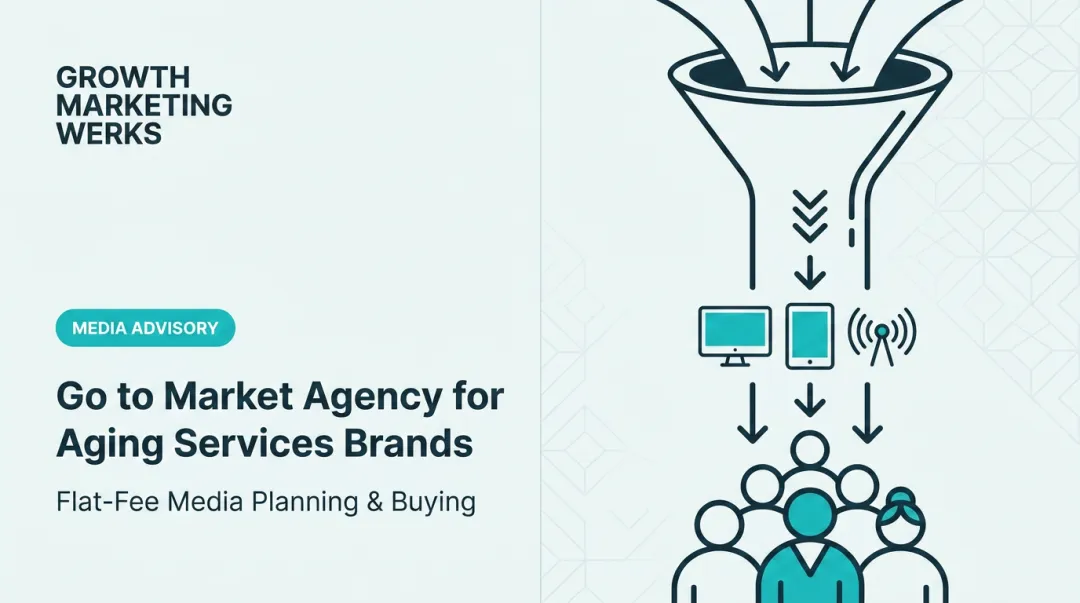
Building a Full-Funnel Paid Media Strategy
A full-funnel approach for senior care looks like this:
| Funnel Stage | Goal | Channels |
|---|---|---|
| Awareness | Introduce the brand | Programmatic display, CTV, social |
| Consideration | Educate and build trust | Retargeting, email, content syndication |
| Conversion | Drive inquiries and consultations | Paid search, landing pages, CRM targeting |

The mistake most agencies make is collapsing all of this into one campaign type and wondering why performance is inconsistent. Each stage needs its own budget, creative, and measurement method.
That's where a media advisory partner adds real value: building the connective tissue between stages so each dollar earns its place. Growth Marketing Werks uses a flat-fee model so their incentives align with client growth rather than budget size. The goal isn't more spend. It's better outcomes from the spend you already have.
Grow Through Referrals and Professional Partnerships
Professional referrals carry built-in credibility that no ad campaign can replicate. According to Activated Insights benchmarking data, the top referral sources for home care agencies break down as follows:
- Past/current clients and family members: 19.5%
- Hospital discharge planners: 8.8%
- Medicare-certified home health agencies: 7.1%
- Skilled nursing facilities: 5.9%
The highest-priority partners to cultivate: hospital discharge planners, primary care physicians, geriatric care managers, elder law attorneys, and area Agency on Aging case managers. Approach these relationships as mutual service partnerships, not as sales calls. Lead with how you can make their work easier. That's what turns a cold introduction into a lasting referral source.
Beyond these primary contacts, faith communities, senior centers, and financial planners are worth building into your outreach. Families who receive a recommendation from a pastor, a senior center coordinator, or a trusted financial advisor are already primed to act because the trust is embedded in the referral itself.
One underused tactic: treat complementary agencies as partners, not competitors. A home care agency and an assisted living community serve different care levels and can refer to each other naturally. Regular check-ins and co-hosted educational events give both parties something concrete to offer families and can convert a name-in-a-contacts-list into a referral partner who actually calls.
Use Video and Social Media to Build Trust at Scale
Video lets families see your environment, your staff, and your culture in ways that written content simply cannot. The most effective formats for senior care:
- Staff introductions: families want to know who will be caring for their loved one
- Virtual tours: especially valuable for families who can't visit in person initially
- Client or resident testimonials: real stories from real families convert hesitant decision-makers faster than any testimonial page can
- Day-in-the-life walkthroughs: shows what daily experience actually looks like
For social media, Pew Research reports that YouTube reaches 85% of adults 50–64 and 64% of adults 65+, making it the largest platform for this demographic, not Facebook, as many agencies assume. Facebook reaches 74% of 50–64 year-olds and remains the primary community-building platform. Both deserve dedicated attention.

Knowing where your audience spends time is only half the equation. What you post matters just as much, and for senior care, credibility and community almost always outperform straight promotion:
- Resident milestones and family moments (with consent)
- Staff recognition and tenure highlights
- Educational caregiving content for family decision-makers
- Honest answers to the questions families are afraid to ask
Posting consistency matters more than posting frequency. One well-considered post per week outperforms three rushed ones. Micro-influencers such as local geriatric care advocates, senior wellness bloggers, or respected healthcare professionals already have the trust of audiences you want to reach. Amplifying their content through paid social can extend that credibility far beyond what organic reach alone delivers.
Measure, Attribute, and Optimize Your Marketing Spend
Senior care has one of the more difficult attribution environments in any industry. The sales cycle for assisted living averages over 300 days. Decisions involve phone calls, in-person tours, family meetings, and months of consideration, none of which automatically populate a digital dashboard.
Last-click attribution will systematically undervalue your awareness channels. A family that first saw your agency through a CTV ad, then clicked a retargeting display ad, then searched your name and converted: that conversion belongs to all three touchpoints, not just the final search.
KPIs Every Senior Care Agency Tracks
- Website traffic by source with conversion rate tracked separately for each channel
- Cost per lead by channel, broken out so underperforming sources can't hide behind blended averages
- Lead-to-consultation rate: how many inquiries actually become scheduled tours or assessments
- Referral source volume, tracking which partners generate the most qualified leads
- Cost per new client, the metric that ultimately validates every other number

Set benchmarks, review them consistently, and hold your channels accountable to outcomes, not activity.
That accountability is only possible when your data lives in one place. Unifying paid media, website analytics, and CRM data into a single view eliminates the disconnect between platforms so you can see the full picture instead of reconciling three separate reports. Growth Marketing Werks uses Datorama-powered attribution reporting to do exactly that, connecting campaign activity to revenue outcomes and helping agencies decide where the next dollar goes.
Frequently Asked Questions
What is the best way to market to older adults?
Effective senior care marketing requires understanding the dual audience: the older adult receiving care and the adult family member driving the decision. Use trust-building, aspirational messaging rather than deficit-based language, and deploy a multichannel approach that combines digital, paid media, and community referrals tailored to where each audience is in their decision journey.
What are the 5 P's of healthcare marketing?
The 5 P's are Product, Price, Place, Promotion, and People. For a senior care agency, that means defining your services, communicating pricing transparently, showing up in the right channels, messaging appropriately, and prioritizing the people factors such as staff quality, family responsiveness, and resident experience that drive trust and referrals.
What is the 40-40-20 rule in marketing?
The 40-40-20 rule holds that marketing success is 40% audience targeting, 40% offer, and 20% creative. In senior care, getting segmentation right (older adults vs. family caregivers, care level, geography) matters as much as any ad you run.
How do you build a referral network for a senior care agency?
Start with hospital discharge planners, primary care physicians, geriatric care managers, and elder law attorneys. Approach each relationship as a mutual service partnership rather than a referral request. Consistent check-ins, co-hosted events, and resource sharing build the trust that generates ongoing referrals. One-off asks don't.
What digital marketing channels work best for senior care agencies?
Local SEO and Google Ads capture high-intent families already searching for care, while Facebook and Instagram ads reach adult children in the 45–65 demographic. Email nurtures long-cycle prospects over months, and programmatic display or CTV builds awareness before families start actively searching so your name registers when the decision arrives.
How do you measure the success of senior care marketing campaigns?
Track cost per lead by channel, lead-to-consultation rate, referral source volume, and new client acquisition cost. Because the senior care sales cycle involves offline touchpoints such as phone calls, tours, and in-person meetings, full-funnel attribution that connects digital activity to downstream outcomes is essential. Last-click measurement alone will consistently mislead budget decisions.