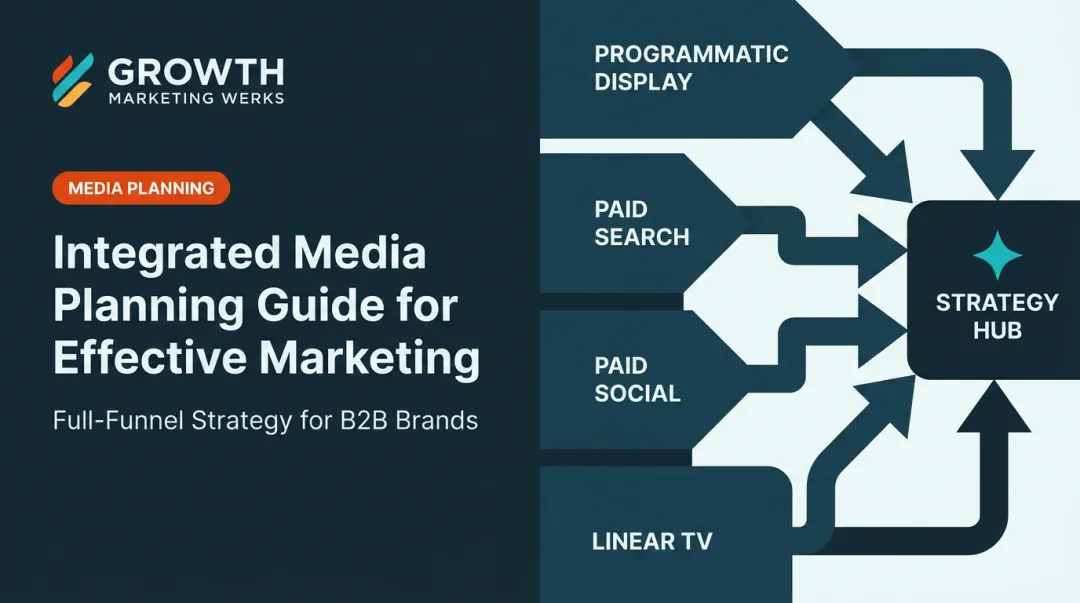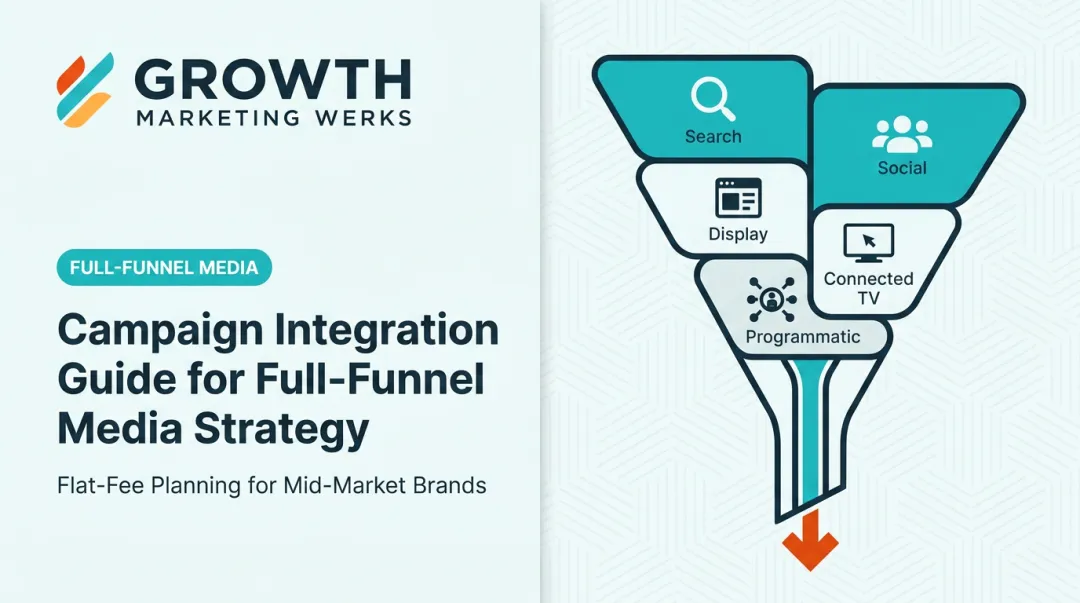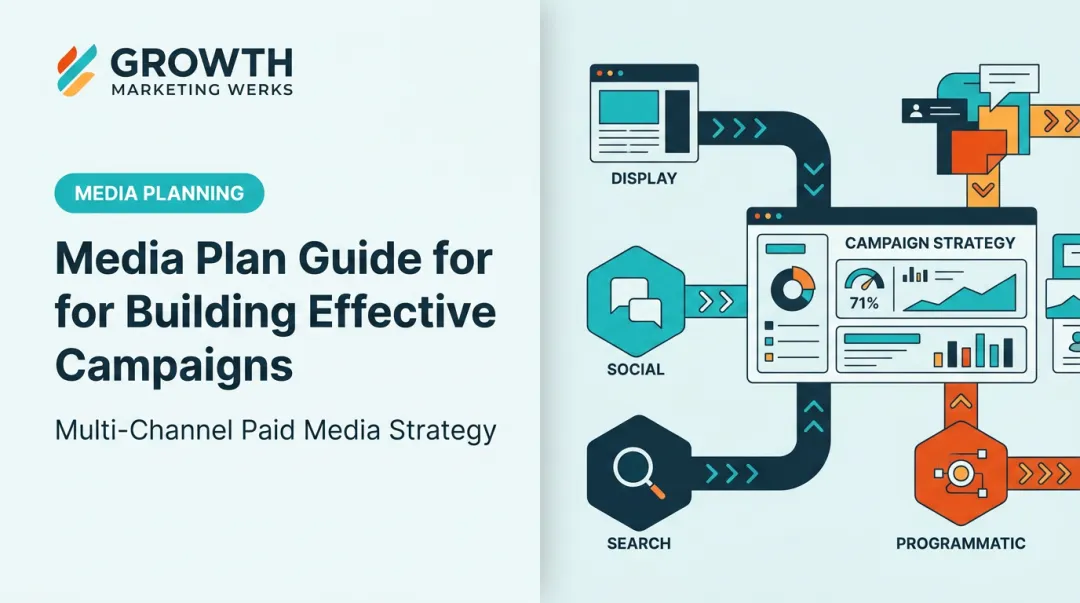

Without one, media budgets get spent reactively. Channels get chosen because they feel familiar, not because they fit the audience. Campaigns launch without measurement frameworks, making it impossible to prove what worked.
This guide is written for marketing leaders, brand managers, and mission-driven organizations (including AgeTech, CPG, nonprofit, and government organizations serving the older adult market) who want to invest media dollars purposefully. It covers what a media strategy is, why campaigns fail without one, how the 5 M's framework works, and a step-by-step process for building one.
Key Takeaways
- A media strategy defines your audience, channels, budget, and success metrics before a campaign launches
- The 5 M's (Mission, Money, Message, Media, Measurement) prevent the most common failure: choosing channels before defining goals
- For mission-driven organizations with constrained budgets, precise audience definition is non-negotiable. Untargeted spending is waste you can't afford
- Measurement infrastructure must be built at campaign start, not retrofitted afterward
- Mid-campaign optimization only works when tracking is in place from day one
What Is a Media Strategy?
A media strategy is the overarching plan governing how a brand communicates across paid, owned, and earned media channels. It defines who you're reaching, what you're saying, where and when you're saying it, and how you'll measure what worked.
How It Differs from Media Planning and Media Buying
These three terms are related but distinct:
| Term | Role | The Question It Answers |
|---|---|---|
| Media Strategy | The why and what | What are we trying to achieve, and for whom? |
| Media Planning | The blueprint | Which placements, dates, and budgets? |
| Media Buying | The execution | How do we secure and traffic the placements? |

As Amazon Ads defines it, media planning creates the guide for a campaign, while buying is the subsequent step of purchasing placements. Strategy sits above both and gives them direction.
The Omnichannel Reality
Modern media strategies span a media environment split across dozens of channels and devices. According to IAB/PwC data, U.S. digital ad revenue reached $259 billion in 2024, up 15% year-over-year. Digital video alone is projected to capture nearly 60% of all TV/video ad spend in 2025.
The challenge isn't access to channels. It's integrating them. A strategy that treats programmatic, CTV, paid social, and search as disconnected campaigns produces:
- Fragmented audience experiences across touchpoints
- Diluted messaging that fails to build cumulative impact
- Budget spread thin without strategic sequencing
Coherent omnichannel planning turns scattered spend into strategic investment.
Why Campaigns Fail Without a Clear Media Strategy
The Wasted Spend Problem
Without defined objectives tied to business goals, channel decisions default to habit or vendor recommendations. The cost is measurable: the ANA's Q2 2025 Programmatic Transparency Benchmark reported $26.8 billion in wasted global programmatic media value in a single quarter.
That's not a technology problem. It's a strategy problem. Waste accumulates when spend decisions aren't anchored to audience definitions and measurable outcomes.
The Unique Risk for Mission-Driven Organizations
Nonprofits and organizations serving the older adult market operate under tighter constraints than most. M+R's 2025 benchmarks found that nonprofits reinvested $0.10 in digital ads for every $1 of online revenue, a ratio that leaves no room for untargeted spending. Every media dollar must work harder, which makes strategic prioritization and audience definition essential before any channel is selected.
For organizations where budgets face donor scrutiny or board oversight, the question isn't just "did the campaign perform?" It's also "can we defend every dollar we spent?"
The Attribution Gap
Nielsen's 2025 Annual Marketing Report revealed a striking gap: 85% of marketers are confident measuring ROI, but only 32% actually measure holistic ROI. Another 38% don't measure traditional and digital channels together.
Campaigns without pre-established measurement frameworks can't attribute results to specific channels. Without that foundation, organizations hit the same three walls:
- Can't optimize mid-campaign when performance data lacks channel context
- Can't demonstrate ROI to stakeholders with fragmented measurement
- Can't carry forward learnings, turning each campaign into a sunk cost
The 5 M's of Media Strategy: A Framework for Building Every Campaign
The 5 M's, adapted from Kotler's foundational advertising framework, function as a practical checklist that ensures no critical element is skipped. They prevent the most common failure mode: selecting channels before defining objectives, audience, and message.

Mission (Objectives)
Every strategy starts with a specific, measurable goal. Not "increase awareness," but rather increase unaided brand awareness by 15% among adults 45-65 in three target markets within six months.
Goals follows a SMART format (Specific, Measurable, Achievable, Relevant, Time-bound) to create accountability. Without this anchor, channel selection, budget allocation, and creative development all default to guesswork.
Money (Budget)
Budget shapes what a strategy can realistically accomplish. It determines channel mix, reach, frequency, and duration. A $15,000 quarterly budget warrants a different channel architecture than $150,000, and both deserve strategic rigor.
Traditional commission-based media buyers are compensated as a percentage of media investment, creating an inherent incentive to recommend larger budgets regardless of results. Growth Marketing Werks was built on a flat-fee model specifically to remove that conflict, so budget recommendations are tied to outcomes, not to the advisor's revenue.
Message (Creative)
Message refers to the value proposition, creative format, and call-to-action. Format complexity directly determines channel fit. A campaign built around video storytelling needs channels that support it: CTV, digital video, social.
A campaign using long-form content for a complex enterprise value proposition needs contextual placements where attention is available.
A practical test: if the message can't be meaningfully communicated in the channel's native format, the channel isn't the right fit.
Media (Channels)
Channel evaluation is based on four criteria:
- Audience match: Is the target audience active here with sufficient concentration?
- Targeting capabilities: Can the channel reach the right segments with precision?
- Cost efficiency: What are the CPM, CPC, or CPA benchmarks relative to alternatives?
- Creative compatibility: Does the channel support the required message format?
A balanced omnichannel mix typically combines paid media (programmatic, search, social, CTV) with owned touchpoints (website, email) and earned exposure (press, referrals). Each plays a different role across the awareness-to-conversion funnel, and each deserves a distinct objective.
Measurement (Analytics and KPIs)
Measurement can't be bolted on after launch. The following infrastructure must be in place before the first impression runs:
- Conversion pixels on key landing pages and confirmation pages
- UTM parameters on all paid placements
- Call tracking for phone-driven conversions
- A unified reporting framework that aggregates data across channels
Key metrics span the full funnel: reach and frequency at the top, engagement and click-through in the middle, conversion rates and cost-per-acquisition at the bottom. Get this infrastructure in place before launch, and mid-campaign optimization becomes a structured process rather than a reactive scramble.
How to Build a Media Strategy: Step-by-Step
No two strategies are identical, but the following five steps form a repeatable process that applies across industries, campaign types, and budget sizes.
Step 1: Define Your Goals and Target Audience
Every strategy begins with two locked-in answers:
- What specific outcome must this campaign produce? Include a quantitative target and timeline.
- Who is the campaign trying to reach? Define demographics, psychographics, media consumption behaviors, and purchase motivations.
Research tools such as first-party CRM data and syndicated audience data from sources like MRI-Simmons or Nielsen are essential inputs. Assumptions about audience behavior are a liability.
For campaigns targeting organizations serving the older adult market, this step carries extra weight. Pew Research found that only 10% of adults 65+ use TikTok, compared to 62% of adults 18-29. Platform assumptions that work for one demographic actively fail for another.
Step 2: Analyze the Competitive Landscape
Competitive media intelligence shapes where and how to invest. The outputs of this analysis answer:
- Which channels do competitors dominate, suggesting saturation or opportunity?
- What messaging themes recur, and where is there room to differentiate?
- When do competitors concentrate spend, and are there timing windows with less noise?
Nielsen defines share of voice as a brand's media investment in the context of total category expenditure. Understanding your SOV relative to competitors reveals whether you're fighting for attention in a crowded channel or finding whitespace where your message can land harder.
The goal isn't to copy what competitors do. It's to find where they're not and whether that gap represents an underserved audience or a channel that simply doesn't work.
Step 3: Select Your Media Mix and Allocate Budget
Channel selection follows from the first two steps: audience match, creative fit, and cost-per-outcome benchmarks drive the decision.
A few tradeoffs to address explicitly in every strategy:
- Reach vs. frequency: Spreading thin to maximize reach often produces insufficient frequency in each channel, diluting impact. Concentration in fewer well-chosen channels typically outperforms a thin spread.
- Brand-building vs. performance: Upper-funnel channels build the audience that lower-funnel channels convert. Both need budget.
- Proven vs. test-and-learn: Reserve a portion of budget (typically 10-20%) for testing new channels or formats. Build in flexibility for mid-campaign reallocation.
Step 4: Develop Your Scheduling and Timing Strategy
Three scheduling approaches apply to most campaigns:
- Continuity: Consistent presence year-round. Works well for always-on demand generation and brands maintaining long sales cycles.
- Flighting: Concentrated bursts with dark periods between them. Effective for seasonal products or campaigns where budget doesn't support continuous presence.
- Pulsing: A baseline of activity with heavier bursts tied to demand spikes or key events.

For nonprofits, timing strategy isn't optional. It's critical. M+R's data shows that 37% of all nonprofit online revenue arrives in December, with 4% on the final day of the year alone. A pulsed strategy that builds awareness in October and November, then concentrates conversion spend in December, maps directly to that donor behavior pattern.
Step 5: Launch, Measure, and Optimize
Campaign launch is the start of the optimization cycle, not the end of planning. Weekly or biweekly performance monitoring against pre-established KPIs enables mid-flight decisions: reallocating budget from underperforming channels, swapping creative that isn't converting, and adjusting audience targeting based on engagement signals.
A unified data dashboard aggregates results across all channels into a single view rather than requiring teams to pull reports from disconnected platforms. Growth Marketing Werks uses Datorama for this purpose. Five optimization levers are available mid-campaign:
- Targeting: Adjust audience segments based on real-time signals
- Tactics: Shift between ad formats or placements
- Partners: Move spend away from underperforming media partners
- Budget: Redistribute dollars to stronger-performing channels
- Creative: Swap or refine assets based on engagement data
Common Media Strategy Mistakes and How to Avoid Them
Channel-First Planning
Selecting channels before defining the audience and objectives is the most pervasive mistake. It leads to spending in channels that feel familiar rather than channels that actually reach the intended audience with sufficient frequency and relevance. Channel selection is a conclusion, not a starting point.
To avoid this, define your audience profile, objectives, and KPIs before any channel enters the conversation. Let the data point to the channel, not the other way around.
Treating All Channels as Equivalent
Each channel plays a distinct role in the customer journey. A brand awareness display campaign and a conversion-focused search campaign measure success differently. Assigning the wrong KPI to the wrong channel (measuring a CTV awareness campaign by immediate cost-per-acquisition, for example) produces false conclusions about what's working and what isn't.
Map each channel to its intended funnel stage, then assign KPIs that reflect that stage: reach and frequency for awareness, cost-per-lead or return on ad spend (ROAS) for conversion.
Retrofitting Measurement
Organizations that don't configure tracking infrastructure before launch face a compounding problem:
- They can't attribute results to specific channels
- They can't optimize mid-campaign because they don't know what's driving performance
- They can't generate post-campaign learnings that would improve future strategy

Every campaign without proper tracking from day one is a sunk cost rather than a learning asset. Research on measurement confidence consistently shows most organizations believe they're measuring well, yet the gap between perceived and actual measurement coverage is significant. Configure tracking before launch, not after.
Frequently Asked Questions
What is a media strategy?
A media strategy is a comprehensive plan defining how a brand communicates with its target audience across channels: what the message is, who it's for, where it appears, and when it runs to achieve specific business outcomes. It governs all channel, budget, and creative decisions before a campaign launches.
Can you give me some examples of media strategies?
Two common examples: (1) A nonprofit running a pulsed awareness and fundraising campaign across CTV and paid social, concentrated in Q4 to align with December giving behavior. (2) An enterprise organization using LinkedIn Sponsored Content for awareness, Google search for intent capture, and programmatic retargeting to move prospects toward conversion.
What are the 5 M's of media strategy?
The 5 M's (Mission, Money, Message, Media, and Measurement) form a planning checklist adapted from Kotler's advertising framework. Together, they ensure every critical element of a strategy is addressed before a campaign launches.
What are the 7 C's of social media strategy?
The 7 C's framework covers Content, Community, Conversation, Social Capital, Culture, Collaboration, and Conversion. It's specific to social media planning, ensuring each platform serves a clear purpose and that engagement drives toward measurable outcomes.
What is the difference between media strategy and media planning?
Media strategy defines the overarching "why and what": goals, audience, channel rationale, and success criteria. Media planning translates that strategy into a detailed execution blueprint covering specific placements, flight dates, budget by channel, and creative specs. Strategy comes first; planning implements it.
How do you measure the success of a media strategy?
Success is measured against KPIs set before launch: reach, frequency, cost-per-acquisition, ROAS, lead volume, or brand awareness lift, depending on the objective. Accurate measurement requires tracking infrastructure (pixels, UTM parameters, unified reporting) built in from day one, not retrofitted after launch.