
Introduction
There are roughly 41,465 assisted living communities operating across the United States today, and the competitive pressure on each one is only going to intensify. The U.S. Census projects the 65+ population will grow from 56.1 million in 2020 to 73.1 million by 2030, a surge that draws more providers into the market even as families become more selective about where their loved ones live.
Generic marketing doesn't cut through here. Choosing an assisted living facility is one of the most emotionally charged decisions a family makes, typically unfolding over months with multiple stakeholders pulling in different directions. A flyer or a single Google ad won't move that needle.
A full-funnel approach works: one that builds trust early, meets families where they are in the decision process, and connects every tactic to a measurable outcome. The sections below cover understanding the assisted living buyer, building a high-converting digital presence, running paid and programmatic advertising, developing referral networks, and tracking ROI with the rigor the budget demands.
Key Takeaways
- Assisted living marketing targets two audiences at once: the older adult resident and the adult child driving the research.
- A fast, mobile-optimized website with strong local SEO is the non-negotiable foundation.
- Paid advertising accelerates lead generation most when combined with strong attribution, so every dollar traces back to an inquiry, tour, or move-in.
- Professional referral networks generate a significant share of qualified leads at high ROI.
- Every marketing dollar must connect to a measurable outcome: inquiry, tour, or move-in.
Know Your Audience: Older Adults, Adult Children, and the Decision-Making Dynamic
Most assisted living marketers underestimate the dual-audience problem. The older adult resident is the ultimate beneficiary, but adult children (particularly daughters and daughters-in-law) are typically the ones initiating research, comparing options, and driving the final decision. According to a 2025 A Place for Mom survey, 66% of family caregivers are women, with nearly 45% aged 60 or older. Your messaging must serve both audiences, but in very different ways.
Mapping the Decision-Making Journey
The same survey found that more than two-thirds of families who secure senior care search for 60 days or less. That's a short window. However, 54% of caregivers wish they had started planning sooner, which means many families are already behind when they finally start searching.
What triggers the search matters, too:
- 73% of searches begin gradually, driven by a slow accumulation of concerns about daily functioning
- 24% stem from a specific event like a fall or hospitalization
- The remaining families are often already in crisis by the time they engage

The right moment to reach a family isn't always a crisis. It's often a quiet Tuesday when an adult daughter realizes her father can no longer manage meals on his own.
Messaging speaks to these moments with reassurance, not alarm. Framing around dignity, peace of mind, and quality of life outperforms fear-based appeals consistently.
Building Audience Personas for Each Stakeholder
The adult child persona typically looks like this:
- Age 45–65, likely employed full-time
- Researching on a smartphone between meetings or after work hours
- Core pain points: guilt about not doing enough, anxiety about safety, uncertainty about costs
- Information needs: staff-to-resident ratios, safety protocols, pricing transparency, and verified reviews
The prospective resident persona is driven by different concerns:
- Fear of losing independence and autonomy
- Strong desire for social connection and community
- Sensitivity to how the community feels (not just how it looks on paper)
- Response to resident testimonials and lifestyle programming
Content strategy follows directly from these differences. Adult children need proof: credentials, reviews, transparent pricing. Older adults need a felt sense of the place. Build your content plan around both, and make sure neither audience has to work to find what's relevant to them.
Building a High-Converting Digital Presence
Most families begin their search online. A 2024 U.S. News survey of adults who recently selected senior living found that 55% read online reviews for every facility they toured, and 59% prioritized health and safety information when evaluating options. Your website is often the first and most important impression you make.
Non-negotiable website elements include:
- Fast load times and mobile optimization (most research happens on phones)
- Virtual tour functionality that lets families explore before visiting in person
- Clear calls-to-action (schedule a tour, request pricing, ask a question)
- Easy access to pricing information, because families who can't find costs move on quickly
Website Optimization and Local SEO
Local SEO is how families find you when they type "assisted living near me" or "memory care in [city]." Before paid media can amplify your reach, these organic foundations need to be in place. The fundamentals:
- Optimize your Google Business Profile: accurate name, address, and phone number; updated hours; recent photos of the community
- Target location-specific keywords on service pages (for example, "assisted living in Denver" rather than just "assisted living")
- Build citations in healthcare directories like Caring.com, Seniorly, and A Place for Mom

Content that ranks well answers the questions families are actually asking:
- "When is the right time for assisted living?"
- "How do I talk to my parent about moving?"
- "What to look for when touring a facility?"
Blog posts and FAQ pages built around these queries serve double duty: they rank in search and they build trust with families who find them.
Online Reputation Management
A 2022 study published in JAGS found that only 60% of the 12,143 assisted living communities studied had Google reviews at all, with an average of just 4 reviews per community. Most facilities leave this channel largely unmanaged, even though families rely heavily on reviews to make their decision.
A proactive reputation strategy includes:
- Asking satisfied families to leave reviews (timing matters; right after a positive milestone works well)
- Responding professionally to every review, positive or negative
- Monitoring Google, Yelp, and senior-specific directories consistently
Video and written testimonials on your website go further than any review platform. A family describing how a community changed their parent's quality of life carries more weight than a paid ad.
To collect these ethically:
- Train staff to identify willing advocates after positive milestones
- Keep the ask simple: a short conversation, not a form
- Let families choose their format (video, written quote, or both)
Paid and Programmatic Advertising Strategies That Accelerate Occupancy
Paid advertising complements organic strategies rather than substituting for them. The strongest assisted living operators run their media budget as one portfolio of campaigns: spanning the full funnel, diversified across channels, driven by data, and reallocated as performance shifts. Growth Marketing Werks works with organizations serving the older adult market as a strategic media partner, building media plans that allocate spend where it actually moves families toward a decision.
Google Ads and Geotargeted Search Campaigns
Google Search Ads capture families who are already looking. These are high-intent queries such as "assisted living in [city]," "memory care near me," and "what does assisted living cost," and appearing at the top of results when someone types them is valuable.
Key execution principles:
- Use location targeting to capture families within a defined geographic radius of your facility
- Structure ad copy around trust signals: care levels offered, staff credentials, community ratings
- Always send paid clicks to dedicated landing pages, not your homepage. A page built around the specific search query converts far better than a generic home screen
Geofencing and geotargeted display ads extend this logic into physical space. Placing ads in front of adults near hospitals, rehabilitation centers, and senior care offices catches families at the moment their urgency is highest, right after a parent has been hospitalized or discharged to a rehab facility.
Social Media and Programmatic Advertising
Facebook remains the dominant platform for reaching adult children. Pew Research data from 2024 shows that 69% of adults aged 50–64 use Facebook, compared to 35% on Instagram. Both platforms support demographic targeting that lets you reach the exact age and geography you're after.
Effective social ad formats for assisted living:
- Carousel ads featuring community lifestyle photography
- Video ads showing a day in the life of residents
- Retargeting campaigns that re-engage website visitors who didn't book a tour
Social ads feel warm and story-driven, not clinical. A photo of residents at a garden event does more to build trust than a bullet list of care services.
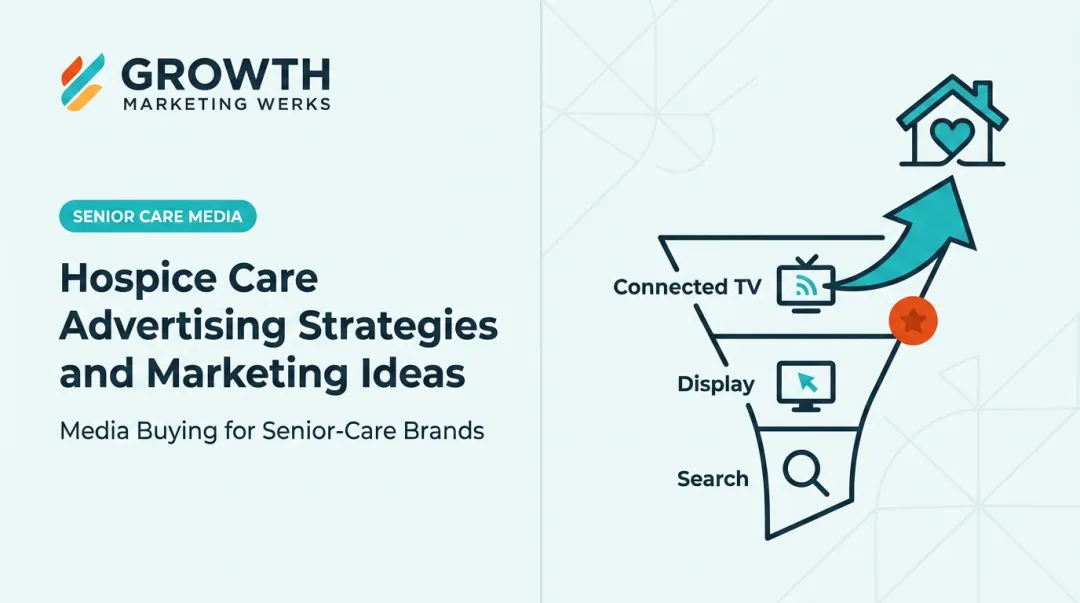
Social tactics handle mid-funnel engagement well, but awareness starts earlier. Programmatic advertising (connected TV, display, and digital audio) builds familiarity with your community before a family even begins active research. By the time they type a search query, your name is already familiar.
The practical implication: unified attribution tracking across paid search and programmatic is critical. Without it, you're flying blind on which channels actually influenced a move-in decision, and rebalancing your budget becomes guesswork.

Referral Programs and Community Events That Drive Move-Ins
Building a Professional Referral Network
Professional referrals are among the most valuable lead sources in assisted living. Research from NIC MAP suggests that up to 70% of assisted living leads come from professional referral sources such as physicians and home health agencies. These relationships require consistent, deliberate cultivation.
Build your referral network by engaging:
- Hospital discharge planners making daily placement recommendations
- Geriatricians and primary care physicians
- Home health agencies whose clients may be approaching the threshold for assisted living
- Elder law attorneys and financial advisors guiding families through care transitions
Tactics that work:
- Regular in-person visits to referral partners (not just a business card drop)
- Lunch-and-learns at your facility for healthcare professionals
- Educational events co-hosted with complementary providers
- Co-marketing with home health agencies or rehab centers
A structured family referral program also delivers strong ROI. Offer a meaningful incentive (a care credit or community gift), make the process simple to follow, and train staff to recognize satisfied families who might refer others.
Word-of-mouth from a trusted source carries more weight than any paid placement in this industry.
Community Events That Generate Leads and Build Trust
Three event types consistently deliver results at different funnel stages:
| Event Type | Examples | Funnel Stage |
|---|---|---|
| Educational | Memory care seminars, financial planning workshops, caregiver support groups | Awareness/Consideration |
| Social Open Houses | Themed tours, chef demonstrations, wellness days | Consideration/Decision |
| Community Engagement | Health fairs, intergenerational programs, nonprofit sponsorships | Awareness/Brand Building |

Each format serves a different purpose. Educational events reach families who are starting to think about options. Open houses convert consideration into a scheduled tour. Community engagement builds brand affinity with people not yet in the market, but who will be.
Tracking ROI and Optimizing Your Marketing Investment
NIC reported assisted living occupancy at 87.7% in Q4 2025, a number that sounds healthy but masks meaningful variation across markets and facility types. A 2025–2026 benchmark report noted that assisted living monthly inquiries dropped 15.2% from 2024 to 2025, with inquiry-to-move-in conversion rates also declining. In that environment, every dollar of media investment needs to trace back to a result.
Every tactic must connect to a measurable outcome: inquiry submitted, tour booked, application filed, move-in completed. That connection requires integrating your marketing platforms (Google Ads, Meta, programmatic) with a CRM so lead sources are accurately attributed rather than guessed at.
Comparing your performance against industry benchmarks is where accountability becomes actionable:
- Inquiry-to-tour rate: approximately 29% (industry content average)
- Tour-to-move-in rate: approximately 31%
- Web inquiry share: approximately 55% of total leads

If your numbers fall below these benchmarks, the data will show you where the funnel is leaking. Growth Marketing Werks addresses this through Datorama-powered reporting dashboards that consolidate multi-channel performance into a single view, connecting upper-funnel impressions to lower-funnel conversions without requiring manual data reconciliation.
The 80/20 principle applies clearly here: once attribution is in place, most facilities find that a small number of channels generate the majority of qualified leads. Identify those channels, increase investment in them, and pull back on what isn't producing. This full-funnel portfolio approach, which means reallocating based on performance data rather than assumption, is how facilities stop burning budget on tactics that feel productive but aren't moving occupancy.
Frequently Asked Questions
How do you get clients for your assisted living facility?
The most consistent results come from combining digital marketing (local SEO and paid search), professional referral relationships with hospital discharge planners and healthcare providers, community events, and active online reputation management. No single channel reliably fills a census. A coordinated multi-channel approach is what moves the needle.
What are the five key marketing strategies for assisted living?
The five highest-impact strategies are:
- Build a strong website optimized for local SEO
- Run targeted paid advertising on Google and Meta
- Develop a referral network with healthcare providers and discharge planners
- Produce authentic content and video that reflects your community
- Actively manage online reviews across key platforms
What is the 80/20 rule in senior living marketing?
The 80/20 rule (Pareto Principle) means roughly 20% of your channels and tactics will generate 80% of your qualified leads. Identifying that 20% requires tracking ROI across all channels, and once identified, those high-performing channels deserve disproportionate budget and attention.
How much does an assisted living facility spend on marketing?
Nonprofit senior living operators spent an average of 4.86% of operating budgets on marketing in 2022, with multisite operators spending 6.3% versus 4.22% for single-site communities. How budget is allocated across channels matters as much as the total amount. A well-structured $50,000 outperforms a poorly allocated $200,000.
How do I market assisted living to adult children of older adults?
Adult children respond to Facebook and Instagram ads, Google Search campaigns targeting caregiving keywords, and content that speaks directly to their emotional concerns such as guilt, safety, and distance. Transparent pricing and detailed staff profiles build the trust that gets them to call.
What digital channels work best for assisted living?
Each channel plays a distinct role:
- Google Search captures high-intent local queries and drives the fastest path to inquiries
- Facebook and Instagram reach adult children with emotionally resonant content
- Blog content nurtures families across the extended decision cycle
- Email re-engages leads who aren't ready yet
Running these in a coordinated strategy, not in isolation, is what drives sustained results.