
That assumption is wrong, and expensive. Adults 65+ are digitally active, financially powerful, and actively researching the products and services that matter to them. Yet most advertising budgets dramatically underweight this demographic, leaving substantial revenue on the table.
This article breaks down exactly who today's older adult audience is, what messaging actually earns their trust, which channels reach them most effectively, and how a full-funnel approach turns media investment into measurable outcomes for organizations serving the older adult market and brands serving older adults.
Key Takeaways
- 78% of U.S. adults 65+ own a smartphone, according to Pew Research Center (2026)
- Adults 50+ represent 36% of the U.S. population but drive more than half of all U.S. consumer spending, totaling over $10.7 trillion annually
- Facebook and YouTube are the dominant digital platforms for adults 65+, with 58% and 60% usage rates respectively
- Trust, clarity, and emotional relevance consistently outperform nostalgia bait, urgency tactics, and feature-heavy creative with older audiences
- Multi-channel campaigns consistently outperform single-channel approaches, particularly for high-consideration decisions like senior living
Why Older Adults Are the Most Underestimated Audience in Advertising
Most marketing advice about older adults is either outdated, overly generic, or frankly condescending. Treating older adults as a tech-resistant monolith means missing one of the most financially significant demographics in the country.
That's a costly assumption. As Harvard Business Review noted in "Don't Underestimate the Market Power of the 50+ Crowd", many businesses use scattershot messaging to people 50+, including irrelevant ads for ailments they don't have. That kind of misfired creative doesn't just waste budget. It actively erodes brand trust with an audience that has decades of experience detecting inauthenticity.
The Scale of the Opportunity
- 61.2 million Americans are currently age 65+, according to the U.S. Census Bureau
- Older adults are projected to outnumber children by 2035
- Households headed by someone 50+ account for $10.7 trillion in annual consumer spending, which is more than half of total U.S. consumer expenditure
- Many adults 65+ have paid off major debts and carry significant disposable income, making them active buyers in health, travel, financial services, and senior living categories
The Dual-Audience Reality
Older adult advertising rarely reaches just one decision-maker. For high-stakes decisions such as senior living, home care, and healthcare, adult children and family caregivers often drive the research process, even when the senior is the ultimate consumer. Effective campaigns account for both audiences simultaneously.
Age-Band Segmentation: 65–74 vs. 75+
That complexity extends within the older adult audience itself. "Older adults" is not one demographic, and the strategic differences between age bands are significant:
- Ages 65–74 ("young-old"): Digitally fluent, active researchers, often making decisions independently, highly reachable through digital channels
- Ages 75+: More relationship-driven, may involve family members in decision-making, respond strongly to trusted voices and personal connection
In practice, this means the 65–74 segment is highly reachable through programmatic display, paid search, and social, while the 75+ segment responds better to broadcast, direct mail, and community-level channels. Channel selection follows the segmentation.

Crafting Messaging That Resonates With Older Adults
Messaging Principles That Build Trust
Trust is the currency of older adult advertising. Older adults have spent decades navigating marketing messages and are quick to recognize when a brand is performing sincerity rather than demonstrating it. Messaging stays transparent, concrete, and grounded in how a product or service genuinely improves quality of life.
What resonates emotionally with older audiences:
- Independence and self-determination
- Staying connected to family and community
- Peace of mind (knowing a decision is sound)
- Belonging and purpose
These themes consistently outperform product-feature-focused creative. Research from Patti Williams and Aimee Drolet found that older consumers showed higher liking and recall for emotional ads than rational ones, a finding that holds up across decades of older adult marketing practice.
That emotional pull extends directly to social proof. According to Pew Research Center data, 23% of adults 65+ say they always or almost always read online reviews before a first-time purchase, and 45% of review readers age 50+ trust online review accuracy. Real customer stories are meaningfully more persuasive with this demographic than stock photography and brand copy.
Design and Accessibility Best Practices
A design barrier that's minor friction for a 30-year-old can be a complete conversion killer for a 70-year-old. Older adult advertising creative requires deliberate accessibility choices:
- Font size: Minimum 18pt for body text; use 14pt bold only where necessary
- Color contrast: At least 4.5:1 contrast ratio for normal text (per WCAG 2.2 standards)
- Layout: Simple visual hierarchy with clear sections; avoid dense or cluttered design
- CTAs: Specific and unambiguous. Use "Schedule a Visit" or "Call Us Today," not vague buttons that require interpretation
Device considerations matter too. Many older adults prefer desktops and tablets over smartphones for reading and browsing. Keep these in mind when testing:
- Design for desktop and tablet viewports, not just mobile
- Test email campaigns at larger screen sizes
- Prioritize legibility over responsive compactness
Best Digital Channels to Reach Older Adults
Social Media: Facebook, YouTube, and Beyond
Facebook remains the anchor platform for this audience. Pew Research Center (2025) reports 58% of adults 65+ and 76% of adults 50–64 use Facebook, with 45% of the 65+ group engaging daily. Facebook Groups organized around hobbies, health topics, and local interests drive genuine community engagement that display placements alone can't replicate. Interest- and lifestyle-based targeting options make it possible to reach older adults with meaningful specificity.
YouTube is the most overlooked channel in senior media plans, and also one of the most effective. 60% of adults 65+ use it, with the 50–64 cohort even higher at 83%. It rewards longer watch times and supports the kind of storytelling that builds trust over time. For brands explaining complex topics like senior living options, financial planning, or health services, that depth is exactly what the consideration cycle demands.
Instagram is growing among younger boomers (ages 50–64), where 35% usage reflects a meaningful audience. Authentic, story-driven video content performs across all three social platforms with this demographic, while polished brand videos tend to underperform relative to real, relatable stories.

Social channels build awareness and affinity, but capturing older adults at the moment they're actively looking requires a different set of tools.
Search, Display, and Email
Google Search captures older adults at the highest-intent moment in their research process. AARP (2025) reports 72% of adults 50+ used a search engine for health information in the prior three months, and Google ranked 28 percentage points ahead of the next most-used health information source. For senior living, healthcare, and financial services, where the consideration cycle is long, search advertising is non-negotiable.
Email marketing consistently outperforms expectations for this demographic. Mailchimp's benchmark data shows a 35.63% average open rate across industries, which is strong by any standard. Older adults respond well to informative newsletters, practical guidance, and relevant offers. The key is accessibility in design:
- Larger font sizes (16px minimum body text)
- Mobile-responsive layouts
- CTAs that are clear rather than clever
- Plain-language subject lines that set accurate expectations
Connected TV and Programmatic Advertising
AARP (2026) reports that 87% of adults 50+ engage in streaming entertainment, with Amazon Prime at 65% and Netflix at 62% among that group. Older adults are cutting the cord, and CTV advertising reaches them in a lean-back, high-attention environment with precision targeting that linear TV cannot match.
Growth Marketing Werks approaches CTV with a focus on supply path transparency, unified cross-screen measurement, and intentional planning that prevents the same household from being saturated across both broadcast and streaming placements. Platforms like Roku Ads Manager provide direct access to premium streaming inventory with first-party audience data, without requiring complex DSP setups.
Traditional Channels That Still Deliver for Older Adults
Traditional media is not dead for this audience. It's trusted. Linear TV, direct mail, and print have been part of older adults' daily routines for decades. That familiarity carries credibility that newer digital channels have to earn over time.
The most effective older adult advertising strategies integrate traditional and digital rather than choosing between them.
Direct Mail
Direct mail stands out as a particularly strong traditional format. It's tangible, it sits on a kitchen counter rather than disappearing in a feed, and it has a longer shelf life than any digital ad. Formats that perform well:
- Postcards for quick, scannable offers
- Printed newsletters for relationship-building and longer content
- Brochures for high-consideration decisions requiring detailed information
Pairing a direct mail piece with a digital follow-up sequence (email, retargeting, or display) strengthens overall campaign performance. The physical piece builds initial credibility; the digital follow-up maintains presence as the prospect moves through research.
Radio and Local Print
Community newspapers, senior-specific publications, and local radio offer reliable reach with audiences who still build daily routines around these media. According to AARP, 86% of adults 50+ have AM radio access in vehicles, with 53% of AM listeners in that group tuning in for news and 42% for talk programming. Local relevance is a key trust signal for older adults evaluating products and services. Community publications and local radio carry that signal inherently.
Building a Full-Funnel Older Adult Advertising Strategy
The senior consideration cycle, especially for high-stakes decisions like senior living or healthcare, is longer and more research-intensive than for younger audiences. A single-channel approach misses prospects at multiple touchpoints where they need education, reassurance, and trust reinforcement before they're ready to act.
What a Multi-Channel Portfolio Looks Like in Practice
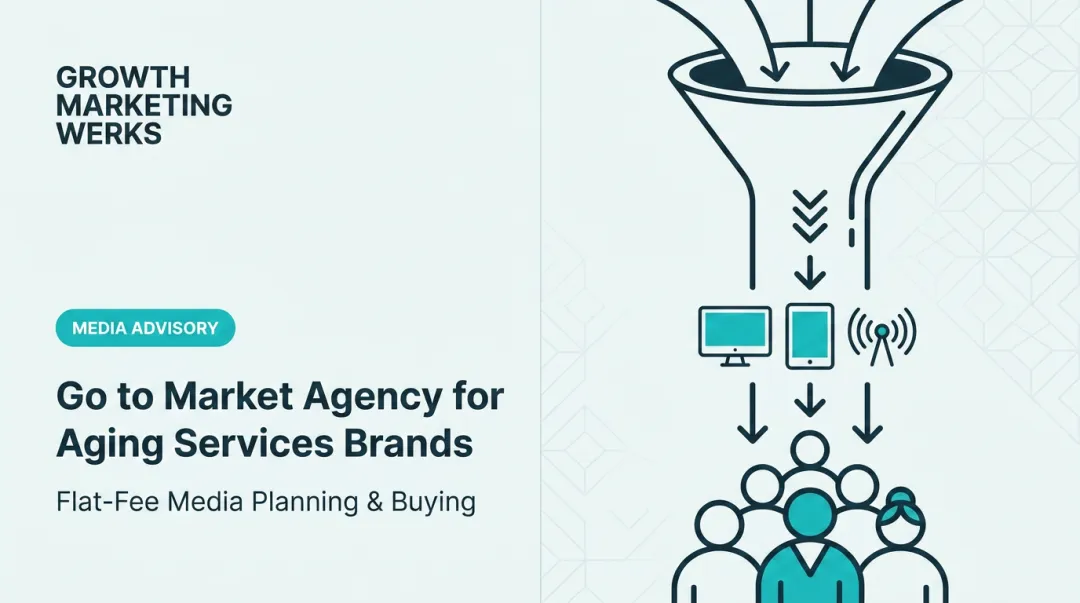
A well-structured full-funnel approach for older adult audiences sequences channels by objective:
| Funnel Stage | Goal | Channels |
|---|---|---|
| Awareness | Reach & brand recognition | CTV, YouTube, programmatic display, broadcast, Facebook |
| Consideration | Education & trust-building | Native advertising, content syndication, email nurture, social retargeting |
| Conversion | Capture active intent | Google Search, programmatic retargeting, geo-fencing, email |

The channels must work together. A CTV campaign that builds awareness has limited value if there's no search strategy to capture the prospects it generates. Email nurture that educates doesn't convert if the landing page experience creates friction. Full-funnel means coordinated, not just running multiple channels simultaneously.
Measurement as the Missing Piece
Most older adult advertising campaigns run ads. But few can track which channels truly drive qualified leads and conversions across the entire user journey.
Full-funnel attribution connects awareness-stage impressions to downstream pipeline activity. Key metrics to track:
- Qualified leads and cost per lead
- Conversion rate at each funnel stage
- Channel attribution across first-touch and multi-touch models
- Pipeline contribution and revenue-influenced activity
For example, our team at Growth Marketing Werks uses tools like Datorama to aggregate performance data from all channels into a single, real-time dashboard.
This centralized visibility is crucial for clients at organizations serving the older adult market who manage complex campaigns reaching older adults, family caregivers, and referral sources. It allows for smarter budget allocation across the full funnel rather than managing channels in silos.
This data-first approach is often supported by a transparent pricing model. A flat fee, for instance, ensures every budget recommendation is driven by performance data, not by what generates more commission.
Frequently Asked Questions
What is the best way to advertise to older adults?
The most effective approach combines trust-focused messaging with a multi-channel presence across digital (Facebook, YouTube, Google Search, email, CTV) and traditional formats (direct mail, TV). Reaching older adults where they already spend time, and building credibility at each touchpoint, consistently outperforms any single-channel strategy.
What products do older adults need most?
Older adults invest heavily in health and wellness, home and personal safety, financial services, travel, and senior living. The most effective advertising leads with how these offerings support independence and quality of life, not product specifications alone.
What social media platform works best for reaching older adults?
Facebook is the dominant platform for adults 65+, with 58% usage and strong daily engagement through Groups and interest-based communities. YouTube is the fastest-growing channel for boomers, particularly for video-based research and trust-building around complex decisions.
How is advertising to older adults different from advertising to younger audiences?
Older adults prioritize trust, transparency, and clarity over trendiness. They have a longer consideration cycle for major decisions and frequently involve family members in their process. Messaging and channel strategy need to account for both the older adult and their family decision-makers.
Does traditional advertising still work for reaching older adults?
Yes. Direct mail, TV, and local print remain highly effective due to long-established trust with older audiences. Integrating them with digital channels, such as pairing a direct mail piece with email retargeting, consistently produces stronger results than either approach alone.
How do you measure the ROI of an older adult advertising campaign?
Track qualified leads, cost per lead, conversion rate, and channel attribution across the full funnel. Full-funnel tracking connects awareness channels like CTV and social to downstream conversions, giving credit where it's due rather than defaulting to the last click.