
This is the daily reality for marketing leaders at AgeTech, CPG, nonprofit, and government organizations serving the older adult market. Disconnected campaigns waste budget and hide the truth about what's actually driving pipeline. This guide breaks down how to integrate campaigns across the full funnel, awareness, consideration, and conversion, into one measurable, cohesive media strategy.
Key Takeaways
- Full-funnel integration unifies every channel under one strategy, message, and data source
- Integration goes beyond multichannel presence, requiring shared audience data and aligned timing
- Consolidating media partners reveals which channel combinations drive conversions
- A structured, repeatable planning process separates high-performing campaigns from disjointed efforts
What Is Campaign Integration in a Full-Funnel Media Strategy?
Campaign integration means coordinating messaging, timing, and channels so every touchpoint reinforces the same story. Instead of awareness, retargeting, and conversion ads operating as isolated efforts, they're built to hand off a prospect from one stage to the next.
Integration vs. Multichannel: What's the Real Difference?
Multichannel just means your brand shows up in multiple places. Integration means those places are working toward one shared objective.
An ERP/CRM provider learned this the hard way. Before working with Growth Marketing Werks, the company ran ads across several platforms, but each channel operated independently with no shared audience logic or messaging plan. The result: wasted spend, audience fatigue, and zero visibility into pipeline impact.
The fix wasn't adding more channels. GMW consolidated fragmented LinkedIn and Google Ads campaigns into one always-on strategy with shared targeting and a full-funnel tracking framework. Within six months:
- Cost per lead dropped 61%
- Click-through rate rose 1,317%
- Sales pipeline return on ad spend (ROAS) hit 2.6x
- 16% of marketing-influenced pipeline converted to revenue

Without integration, channels compete for attention instead of building on each other. That's the trap: presence without cohesion.
Mapping the Three Funnel Stages: Awareness, Consideration, Conversion
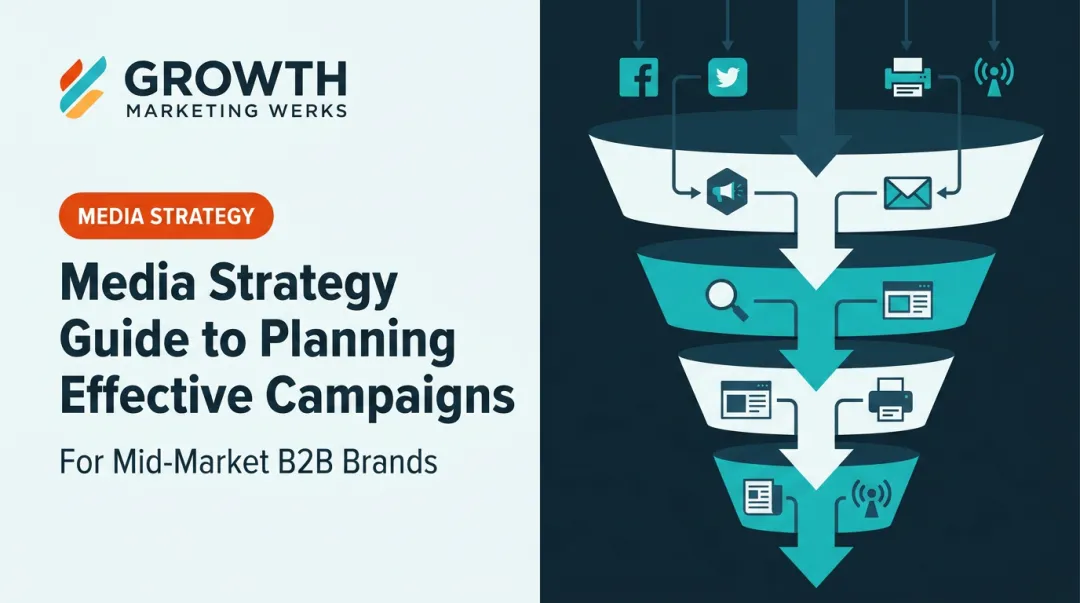
Each funnel stage has a job to do, and the channel mix matches it:
| Stage | Objective | Common Channels |
|---|---|---|
| Awareness | Build reach and frequency with new audiences | CTV/OTT, programmatic display, social, print |
| Consideration | Build trust and engagement | Retargeting, paid social, content/email nurture |
| Conversion | Capture intent, drive action | Paid search, direct retargeting, sales enablement |
Movement between these stages isn't a straight line. A Forrester analysis of business buying behavior found that buyers rated an average of 18 purchasing interactions as valuable during their last successful purchase. That's not a magic number every buyer needs, but it makes one thing clear: judging a campaign by its last click ignores nearly everything that happened before it.
Why Full-Funnel Integration Outperforms Siloed Campaigns
Integration isn't just a nice-to-have. It measurably outperforms single-stage campaigns.
A Nielsen meta-analysis of more than 1,300 campaigns across 20 CPG brands, cited by Think with Google, found that full-funnel campaigns outperformed single-stage efforts. Results included up to 45% higher ROI and a 7% increase in offline sales compared to campaigns confined to one purchase stage. That's a CPG-specific study, so treat it as directional evidence, not a guaranteed outcome for every sector.
What integration reliably delivers, regardless of vertical, is visibility. When channels share data and reporting, you see the full user journey instead of isolated channel snapshots, which is exactly what's missing in most siloed setups.
Core Components of an Integrated Full-Funnel Media Strategy
Four building blocks separate a truly integrated plan from a collection of disconnected campaigns.
Unified Audience Personas That Travel Across the Funnel
Personas shouldn't stop at demographics. They need to map pain points, triggers, and preferred channels at each funnel stage.
For a senior care client, that might mean an adult-child decision-maker who consumes CTV content during the "research mode" phase, then responds to retargeting once they've engaged with educational content. The persona doesn't change between stages; the message and channel do.
A Channel Mix Purpose-Built for Each Funnel Stage
Trying to run one channel mix across every stage is a common (and costly) mistake. Instead:
- Awareness: CTV, programmatic display, print, and publisher-direct placements for reach
- Consideration: Retargeting, content syndication, and native placements for engagement
- Conversion: Paid search, ABM, and direct retargeting for intent capture
Consolidating this execution under fewer, integrated partners also matters. When one team manages the full portfolio, they can spot cross-channel effects that a fragmented vendor lineup would miss entirely.
Take a retail client whose in-store campaign drove an 8x ROAS on digital spend through a halo effect. That connection was only visible because tracking wasn't siloed by vendor.
Consistent Message with Stage-Specific Creative Adaptation
The core value proposition stays constant between stages, while the format and call-to-action change. Brand storytelling belongs at the top of the funnel with a "Learn More" CTA.
Direct-response offers, gated assets, and demo requests belong at the bottom. Pairing a "Buy Now" CTA with an awareness objective sends mixed signals and confuses the algorithm as much as it confuses the audience.
Unified Data and Attribution Across the Funnel
You can't manage what you can't see. A data aggregation layer (GMW uses Datorama for this) pulls performance from every channel into one dashboard instead of forcing teams to reconcile spreadsheets from five different platforms.
This also means shifting away from last-click attribution. The IAB's multi-touch attribution primer notes that last-touch models give 100% of conversion credit to the final ad interaction. That skews investment away from the upper-funnel channels that actually built the intent.
Multi-touch models distribute credit across the journey, giving awareness and consideration channels the recognition (and budget) they've earned.
Step-by-Step: Building Your Full-Funnel Campaign Integration Plan
A structured process is what separates high-performing integration from a lucky guess. Here's the sequence:
- Set funnel-specific KPIs. Use reach and frequency for awareness, engagement and view-through for consideration, and CPL/CPA for conversion, all tied back to overall business goals like pipeline or revenue.
- Map the customer or donor journey. Identify where prospects move between stages and channels. This exposes coverage gaps before they cost you budget.
- Select and sequence complementary channels. Launch awareness channels first to build familiarity, then layer in consideration and conversion tactics so timing reinforces the next stage instead of running on a separate calendar.
- Establish a cross-functional collaboration workflow. Marketing, creative, and sales or development teams need one shared campaign calendar and feedback loop, not three separate ones.
- Build a unified measurement and reporting cadence. Track the full funnel together on a consistent schedule. Quarterly reviews plus ongoing status updates work well, letting you adjust in real time based on which channel combinations are actually converting.
Pro tip: A tool like Datorama consolidates channel data into one dashboard, making quarterly reviews faster and more accurate.

Common Pitfalls That Break Full-Funnel Integration
Even well-intentioned teams fall into the same traps repeatedly:
- Siloed vendors optimizing in isolation. Each agency or platform team optimizes for its own metrics with no shared view of overall funnel performance.
- Inconsistent launch timing or messaging. When top- and bottom-funnel efforts run on different calendars with different stories, audiences get confused and campaign impact dilutes.
- Over-reliance on last-click metrics. This undervalues the upper-funnel channels building the intent that converts later.
These pitfalls carry real business consequences. The same Forrester research cited earlier found that 64% of marketing leaders don't trust their organization's measurement for decision-making, and 61% said their measurement wasn't aligned with business objectives at all. Fragmented attribution is a strategic blind spot that limits leadership's ability to make confident decisions.
How Growth Marketing Werks Builds Integrated Full-Funnel Media Plans
Growth Marketing Werks operates on a flat-fee, full-funnel advisory model, which removes a conflict of interest baked into most commission-based agencies. When an agency earns more by spending more, there's a built-in incentive to overweight high-spend channels regardless of fit.
GMW's flat fee means the only incentive is client growth, so channel allocation follows audience alignment, not commission potential.
That portfolio mindset shows up in how the agency staffs its team. Rather than juggling multiple disconnected vendors, GMW keeps platform-certified specialists in-house across:
- The Trade Desk
- Google Campaign Manager
- Meta
- Datorama
- Demandbase
The same team that plans the strategy also executes and optimizes it, which eliminates the handoff delays that plague multi-vendor setups.
For clients like Pinnacol Assurance, that structure meant consolidating a previously in-house, disconnected search program under one strategic roof, aligning it with the broader brand campaign. The result:
- 1,214% increase in conversion rate
- 7x ROAS from closed deals
Reporting runs through Datorama-powered dashboards, giving clients single-view visibility into full-funnel performance and sales pipeline attribution instead of five separate platform logins.

Frequently Asked Questions
What does "integrated campaign" mean?
An integrated campaign coordinates messaging, timing, and channels so every touchpoint reinforces one unified story. It's the opposite of running independent, disconnected efforts across platforms.
What is campaign collaboration?
Campaign collaboration means marketing, creative, and sales teams work from a shared plan, calendar, and feedback loop. It's what makes integrated strategy execute cohesively instead of breaking down between departments.
What's the difference between full-funnel marketing and integrated marketing?
Full-funnel marketing addresses every stage from awareness to conversion. Integration is the coordination that ties those stages together into one cohesive strategy rather than separate, siloed efforts.
How many marketing channels does a full-funnel campaign include?
There's no fixed number. The right mix depends on your audience and goals, and a few well-coordinated channels will consistently outperform many scattered ones.
How do you measure success across a full-funnel integrated campaign?
You need stage-specific KPIs: reach for awareness, engagement for consideration, and CPL/CPA for conversion. Layer in a unified attribution model that credits each channel's role across the full journey.
Can smaller organizations run full-funnel integrated campaigns on a limited budget?
Yes. Integration is about coordination, not budget size. A few tightly coordinated channels under one strategic plan will outperform a larger, fragmented media buy nearly every time.