
Introduction
You're running paid search, LinkedIn, programmatic display, and email. The dashboards are full of numbers. But when your CFO asks which channels are actually moving the needle, you go quiet.
This is the measurement gap most marketing teams live in: not a lack of data, but a lack of confidence in what the data actually means.
Marketing budgets fell to 7.7% of company revenue in 2024, the lowest level in over three years, according to Gartner's CMO Spend Survey. At the same time, CFOs ranked metrics, analytics, and reporting among their top priorities for 2025. The pressure to prove ROI has never been more direct.
That pressure has focused attention on two methodologies: multi-channel attribution and media mix modeling (MMM). Both matter. Neither is sufficient alone. This guide covers what each does, where each breaks down, and why combining them builds a more defensible measurement foundation, especially as third-party cookies phase out and privacy regulations tighten.
Key Takeaways
- Attribution tracks individual digital touchpoints; MMM uses statistical modeling to estimate channel-level revenue contribution
- Attribution is best for weekly in-channel optimization; MMM is best for budget planning, forecasting, and proving upper-funnel ROI
- Neither method tells the complete story. You need both operating at different decision cadences
- Cross-channel synergies are invisible to attribution models but measurable through MMM
- Combining both methods with incrementality testing gives marketers the most reliable measurement foundation
What Is Multi-Channel Attribution?
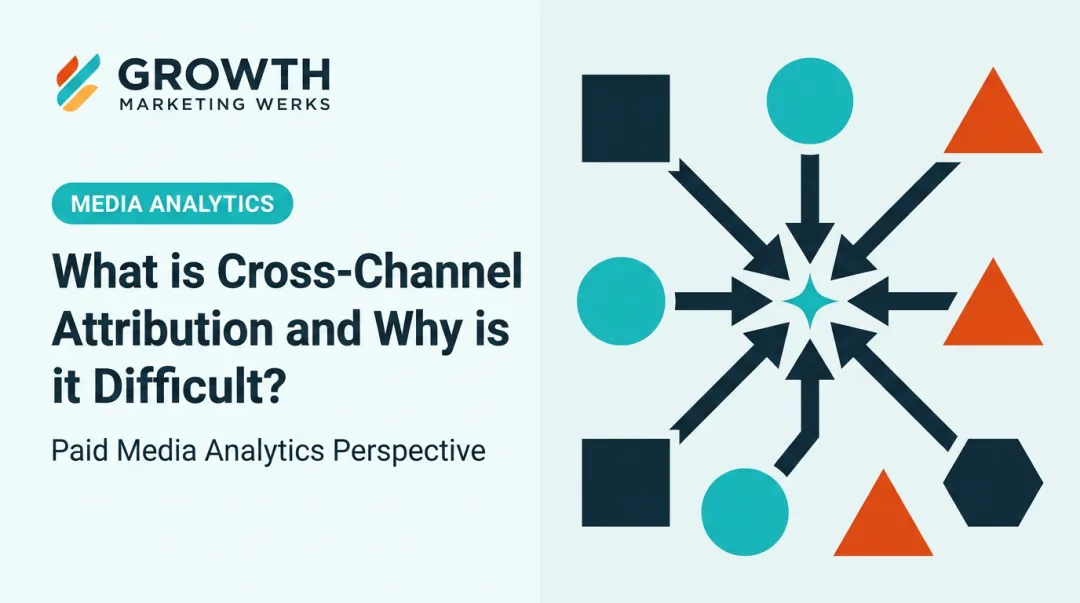
Multi-channel attribution assigns credit for conversions to the various digital touchpoints a prospect interacted with before converting. It works from observable, user-level data: cookies, UTM parameters, CRM records, and ad platform events, to reconstruct the path to purchase.
Common Attribution Models
The model you choose changes which channels appear to "win":
| Model | How Credit Is Assigned |
|---|---|
| Last-touch | 100% credit to the final click before conversion |
| First-touch | 100% credit to the first interaction |
| Linear | Equal credit distributed across all touchpoints |
| Time-decay | More credit to touchpoints closer to conversion |
| Data-driven | Algorithmic weighting based on historical patterns |

Despite the availability of more sophisticated options, 78.4% of senior marketers still use last-click attribution to measure media efficacy, according to a 2024 EMARKETER/Snap survey of 282 senior-level U.S. marketers (platform-sponsored research). Only 21.5% are confident last-click accurately reflects long-term business impact.
What Multi-Channel Attribution Is Good At
Attribution excels at in-channel optimization. Campaign managers use it to understand which ads, keywords, audiences, and creative executions are driving conversion activity on a week-to-week basis.
It works best when digital tracking is clean and consistent:
- Proper UTM tagging across all paid channels
- CRM integration connecting media touches to pipeline records
- Closed-loop conversion data tied back to revenue outcomes
- Consistent event taxonomy across platforms and campaigns
Growth Marketing Werks treats tracking infrastructure as non-negotiable from campaign launch, building full-journey visibility using Google Tag Manager, Google Campaign Manager, and Datorama to aggregate and report across channels.
Where Attribution Breaks Down
Attribution captures what happened in the tracked digital journey near the point of conversion. What it cannot do is explain why that conversion was more likely to happen.
The TV ad someone saw last month, the brand campaign that built familiarity before they searched, the email that first established credibility. None of these show up in a last-click report.
Attribution also assigns credit rather than proving causation. A touchpoint preceding a conversion doesn't mean it caused it. Retargeting ads, for example, routinely intercept buyers who were already committed to purchasing, collecting credit for conversions they didn't drive.
What Is Media Mix Modeling (MMM)?
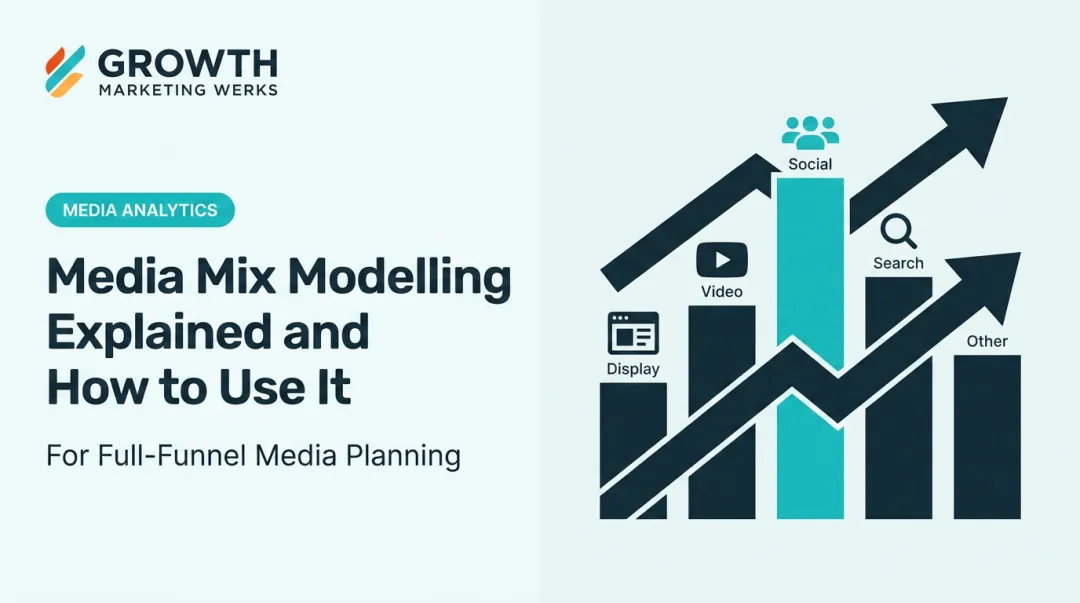
Media mix modeling is a statistical (econometric) method that analyzes historical, aggregated data, including spend levels across all channels, external factors like seasonality and macroeconomic conditions, and business outcomes like revenue or leads, to estimate each channel's incremental contribution to results.
Unlike attribution, MMM is a top-down model. It doesn't track individuals. It identifies patterns across time.
How MMM Works
MMM looks at how variations in marketing spend correlate with variations in business outcomes, while controlling for factors outside the marketer's control. It produces two key outputs:
- Incremental impact estimates: how much revenue each channel contributed, isolated from baseline and external factors
- Diminishing returns curves: showing how additional spend affects performance at different investment levels
MMM requires at least 12–24 months of consistent weekly or monthly spend data across all active channels, aligned with a stable outcome metric: revenue, qualified leads, or pipeline. Offline channels like events, TV, direct mail, and OOH belongs where data exists.
Google describes MMM as the method for estimating marketing contribution "without relying on cookies," making it especially relevant as third-party signal loss accelerates across the industry.
That privacy-driven shift is exactly why MMM has moved from a nice-to-have into a measurement priority for mid-market brands.
What MMM Reveals That Attribution Cannot
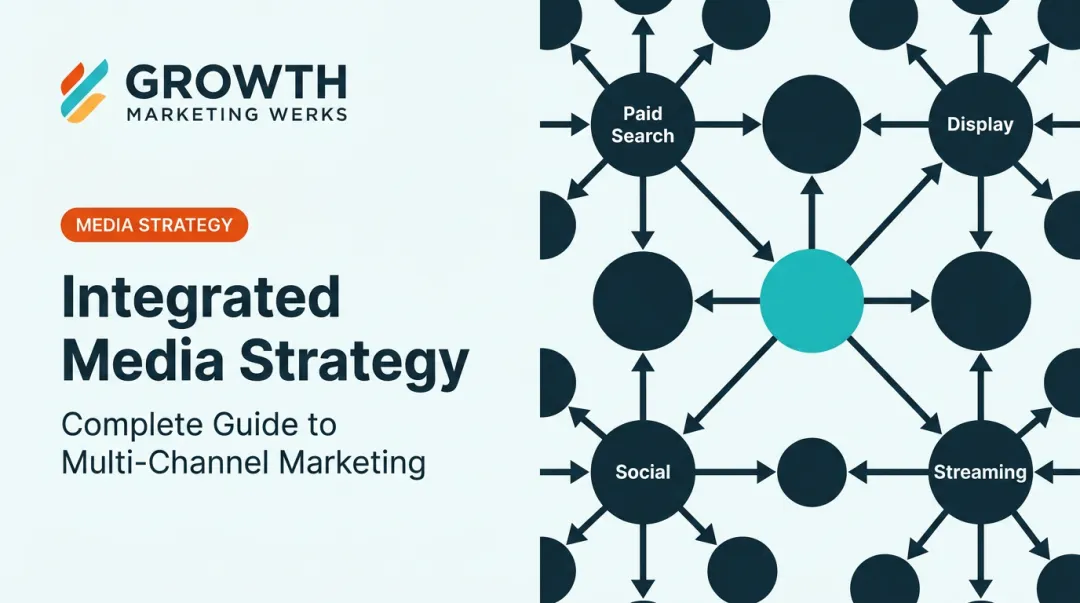
The most significant thing MMM reveals is cross-channel media synergy: the indirect effect of one channel improving the performance of another.
A brand awareness campaign running on video may never receive attribution credit for a single conversion. But if it drives up branded search volume and improves paid search conversion rates downstream, MMM can quantify that relationship. Analytic Partners' ROI Genome research found that 30% of paid search clicks are driven by other forms of advertising, most of which come from video media budgets.
Growth Marketing Werks has observed this dynamic in practice. A Trimble geospatial brand campaign using upper-funnel print, display, and eNews placements produced a 2,234% click-through rate (CTR) increase year-over-year and a 44% improvement in average session duration, clear signals that brand investment was improving audience quality and intent, even as total session volume held steady.

MMM also captures what attribution structurally cannot: the impact of offline media (TV, radio, out-of-home, events) and macroeconomic factors that influence conversion rates independent of media activity.
The Strategic Value of MMM for Budget Decisions
Because MMM estimates true incremental impact rather than assigning credit, its outputs translate directly into budget planning decisions:
- Which channels have room to scale before hitting diminishing returns
- Where spend is over-indexed relative to its true incremental contribution
- How to build a finance-aligned ROI narrative that holds up under CFO scrutiny
This is the measurement layer that connects marketing to the language of the board. Instead of presenting ROAS from a platform dashboard, teams can show defensible incremental revenue contribution from each element of the media portfolio.
MMM vs. Multi-Channel Attribution: What's the Difference?
MMM and multi-channel attribution operate at different layers of a measurement architecture, each answering a distinct set of questions.
| Dimension | Multi-Channel Attribution | Media Mix Modeling |
|---|---|---|
| What it measures | Individual digital touchpoints | Aggregate channel contribution to outcomes |
| Data it uses | User-level tracking events | Historical time-series spend and results |
| Time horizon | Days to weeks | Months to annual |
| Best for | In-channel optimization | Budget planning and forecasting |
Attribution asks: which tracked touchpoints appeared before a conversion?
MMM asks: what would our revenue trajectory have looked like if we had spent differently?
Use attribution for:
- Weekly campaign management and bid adjustments
- Creative testing and keyword optimization
- Understanding which specific ads and audiences are performing
Use MMM for:
- Quarterly budget allocation and annual planning
- Evaluating ROI of brand spend or offline media
- Forecasting revenue impact of spend changes
- Building finance-aligned measurement narratives
IAB's 2024 State of Data report found 70% of brands and agencies are investing or planning to invest in MMM, while 76% are simultaneously investing in new forms of attribution, a clear signal that the measurement conversation has shifted from "which one?" to "how do we run both well?"
Why Attribution Alone Isn't Enough
The Tracking Erosion Problem
Privacy changes have progressively degraded user-level attribution accuracy. Apple's App Tracking Transparency (iOS 14.5, April 2021) required explicit permission before cross-app tracking, and consent management platforms have further reduced trackable journeys.
The downstream effect is measurable. According to IAB's 2024 data, 73% of marketing leaders expected reduced ability to attribute campaign performance due to signal loss, and confidence in platform data has followed: 59% of leaders were less confident in social platform accuracy, 57% in programmatic, and 52% in ad servers.
The Structural Biases Attribution Creates
When used as the sole measurement source, attribution consistently produces predictable distortions. Analytic Partners research found it can overvalue display and search by over 300% while undervaluing social by 44%.
The root causes are structural:
- Over-credits retargeting and last-touch channels: these intercept buyers already near conversion, collecting credit for sales that would have happened anyway
- Under-credits brand and awareness channels: their impact materializes elsewhere in the funnel, never appearing in the attribution window
- Assumes every tracked touchpoint drove incremental value: many didn't

The result: marketers systematically under-invest in channels that build demand and over-invest in channels that merely intercept it.
The Offline Blind Spot
For organizations running TV, radio, direct mail, out-of-home, or sales-driven outreach, attribution captures none of it. Traditional media still represented an estimated $86.72 billion in U.S. ad spending in 2024.
The gap is especially significant in sectors like senior living, where branding and PR ranked as the top marketing tool among 86% of operators surveyed, yet standard digital attribution would record none of that investment's contribution.
Growth Marketing Werks applies different measurement methods to different funnel stages: brand lift studies for awareness-oriented traditional media, direct attribution for conversion-focused digital campaigns.
How to Build a Smarter Measurement Strategy Using Both
The Two-Cadence Triangulation Framework
Organize measurement into two distinct layers operating on different timelines:
Weekly optimization loop (attribution-driven):
- Campaign managers adjust bids, pause underperformers, test creative
- In-channel signals guide day-to-day spend decisions
- Real-time performance data from platforms, aggregated and normalized
Monthly/quarterly planning loop (MMM-driven):
- Marketing leadership and finance align on budget allocation
- Channel ROI validated against true incremental contribution
- Scenario planning for spend changes and forecasting
When the two layers produce conflicting signals (for example, attribution shows a channel performing well but MMM shows low incrementality), that discrepancy is a diagnostic signal, not a contradiction. It usually indicates a tracking gap, a delayed channel effect, or attribution bias that needs investigation.

Bridging Macro and Micro Measurement
One practical application of combining both methods: using MMM outputs to create incrementality coefficients that channel managers can apply operationally.
If MMM reveals that a particular channel's in-platform reported ROAS consistently overstates its true incremental return by 40%, that coefficient can be used to discount reported performance when making bid and budget decisions. Campaign managers get guidance grounded in business-level evidence, not platform-reported numbers, connecting the macro view directly to daily execution decisions.
This is the practical logic behind how Growth Marketing Werks manages media portfolios. Using Datorama to aggregate cross-channel performance data, the team tracks revenue-aligned KPIs (MQLs, SQLs, pipeline contribution, CAC, and ROAS tied directly to revenue) rather than stopping at platform-reported metrics.
The result: clients see the full user journey and attribute pipeline activity to media investment, not just whichever channel happened to be last in the tracked path.
This approach has produced outcomes like a 2.6x Sales Pipeline ROAS for an ERP client, and a 3.7x ROI on influenced revenue for Enstrom Candies, where media investment drove both direct conversions and a measurable halo effect across retail and digital channels.
A single partner overseeing the full media portfolio is what makes this architecture work. With consolidated visibility, that partner can identify channel synergies, correct attribution biases, and keep every budget recommendation tied to business outcomes rather than platform self-reporting.
Frequently Asked Questions
What is the difference between MMM and multi-touch attribution (MTA), and when is each one used?
MTA tracks individual digital touchpoints to assign credit for conversions, which makes it best for in-channel optimization on short time horizons. MMM uses aggregate historical data to estimate incremental revenue contribution across all channels, making it best for budget planning and forecasting. Using both together gives you tactical precision and strategic clarity, each operating at a different level of your planning cycle.
How do consultants handle attribution challenges across multiple channels?
Experienced media consultants use a triangulation approach: combining attribution data for tactical, in-channel decisions with MMM for macro planning, and applying incrementality testing to correct for known attribution blind spots. Neither method works well in isolation; a clean, unified data foundation is what makes both reliable.
What data do you need to run a media mix model?
MMM requires at minimum 12–24 months of consistent weekly or monthly spend data across all active channels, aligned to a stable outcome metric like revenue, qualified leads, or pipeline. Offline channel activity and external control variables (seasonality, economic conditions, competitive factors) belongs where available.
Can multi-channel attribution still work without third-party cookies?
Attribution can continue functioning with first-party data (CRM records, UTM parameters, marketing automation events) even without third-party cookies, but its coverage will be less complete. This is a primary reason MMM has grown in importance: it doesn't depend on individual tracking and remains accurate even as signal loss increases.
How do cross-channel media synergies affect budget decisions?
Cross-channel synergies mean an investment in one channel (like brand awareness or video) can improve results in another (like paid search or direct), but attribution won't capture that connection. When synergies go unmeasured, brands routinely cut upper-funnel spend that was actually driving downstream performance. MMM is specifically designed to surface this relationship before those budget cuts happen.