
Introduction
Most marketing teams are running five channels and telling five different stories. A paid social team optimizing for clicks. A search team chasing conversions. A PR agency pitching a narrative the other two have never heard of. Sound familiar?
This fragmentation isn't just a coordination headache. It's a performance problem. According to McKinsey's 2024 research, business buyers now use an average of 10 interaction channels throughout the buying journey, up from just 5 in 2016. Single-channel campaigns don't move buyers through that kind of complexity.
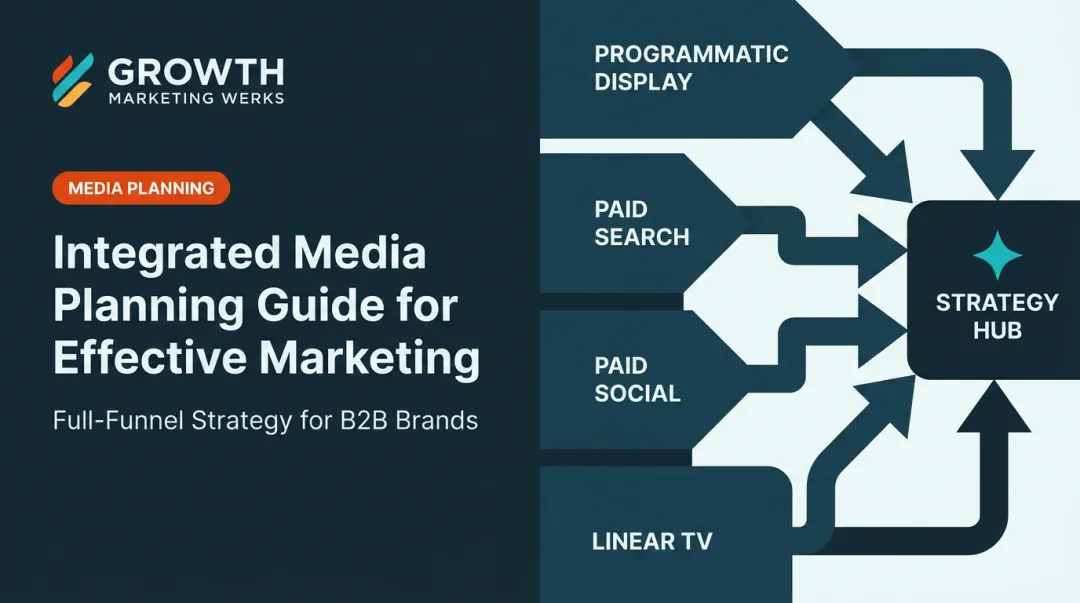
An integrated media strategy fixes this by coordinating every channel, message, and tactic around one brand narrative, so each touchpoint reinforces the last.
This guide covers what integrated media strategy means, how to build a plan, select the right channels, measure results, and avoid the mistakes that drain budget without driving growth.
Key Takeaways:
- Integrated media strategy means channels actively reinforce each other, not just share a budget line
- Paid, owned, and earned media serve distinct roles, and all three must pull in the same direction
- Channel alignment across the full funnel drives performance more than channel count
- Attribution complexity is manageable with unified data infrastructure and consistent tracking
- Start with two or three well-resourced channels and scale based on measured performance
What Is an Integrated Media Strategy?
Coordination, Not Just Presence
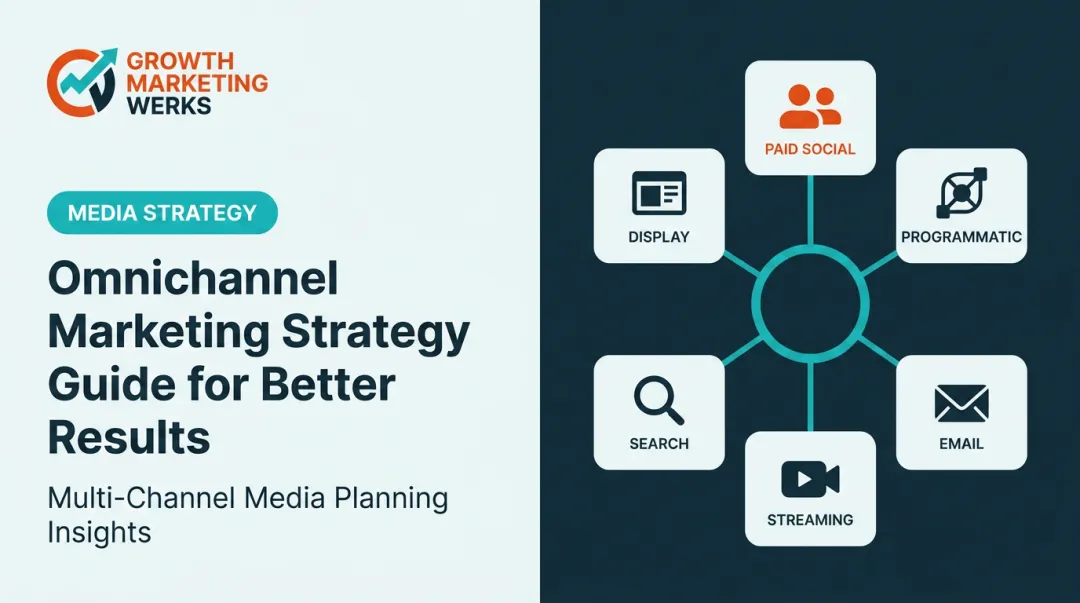
Integrated media strategy is the deliberate coordination of multiple channels (digital and traditional) around a unified brand message and shared business objective.
That distinction matters. Multi-channel marketing means you're present on LinkedIn, running display ads, and sending email campaigns. Integrated media strategy means those three channels share an audience logic, a consistent message, and deliberate sequencing, so a prospect who sees your display ad in the morning recognizes the follow-up LinkedIn post that afternoon.
Without integration, channels compete for credit, duplicate audience reach, and tell inconsistent stories. With it, every touchpoint compounds the last.
Why Buyers Demand Integration
Business buyers averaging 10 interaction channels aren't evaluating your brand in a vacuum. They're comparing touchpoints across weeks or months of research. A brand that sounds authoritative in search but off-message on social, or that runs awareness ads while the landing page screams "buy now," signals disorganization.
A Nielsen meta-analysis cited by Think with Google found that full-funnel strategies generated up to 45% higher ROI and 7% increases in offline sales compared to campaigns targeting a single purchase stage. That's the performance case for integration, not a channel philosophy, but a measurable revenue outcome.
Paid, Owned, and Earned Media: The Three Pillars
Every integrated strategy is built across three media types:
- Paid media: placements you purchase: programmatic display, paid social, SEM, CTV, OOH, broadcast
- Owned media: channels you control: website, email, blog, social profiles, content assets
- Earned media: coverage you didn't buy: press mentions, reviews, word-of-mouth, organic shares
Kantar's 2023 research found that paid media typically delivers only 25% of touchpoint impact, with owned and earned contributing up to 75%. Brands that over-invest in paid while neglecting content and credibility-building underperform those that balance all three.
Here's how the three work together: paid amplifies owned content to new audiences, owned builds the audience that generates earned, and earned validates the paid investment. A gap in any pillar doesn't just reduce that channel's contribution. It limits what the other two can accomplish.

Key Components of an Effective Integrated Media Strategy
Unified Brand Messaging
Integration starts with a single core idea, one message that can be adapted for each channel's format without losing its identity.
Think of how a brand like Starbucks runs TV spots, Instagram stories, and email promotions that all feel like Starbucks, even though the creative executions differ. The core narrative stays intact regardless of format.
In practice, this requires a messaging architecture: a master statement, supporting proof points, and channel-specific adaptations for tone, length, and CTA. The brief, creative, and landing page must tell the same story.
A campaign brief targeting awareness that includes a "Buy Now" CTA is misaligned. That misalignment costs conversions.
Audience Intelligence and Segmentation
Channel decisions follow audience behavior, not the other way around. That means documenting who the target customer is, where they consume media across the day and week, what formats they engage with, and what questions they're asking at each stage of the decision process.
The performance difference is substantial. Nielsen found that campaigns with high audience delivery averaged $2.60 ROI per $1 spent, compared to just $0.25 for campaigns with low delivery, a 10x gap driven almost entirely by targeting precision.
That precision is exactly what Growth Marketing Werks builds into planning from the start, drawing on behavioral, contextual, demographic, CRM-based, and lookalike targeting methods, often informed by Nielsen, MRI, and Comscore data before a single dollar is committed.
Full-Funnel Channel Alignment
Each channel owns a deliberate role in moving audiences through the funnel. A common mistake is concentrating every channel at mid-funnel, with no awareness layer feeding the top and no conversion layer capturing the bottom.
A functional alignment looks like this:
| Funnel Stage | Objective | Channels |
|---|---|---|
| Awareness | Reach, brand recognition | CTV, broadcast, OOH, programmatic, digital audio |
| Consideration | Education, trust-building | Content syndication, paid social, native, retargeting |
| Conversion | Direct response, pipeline | SEM, ABM, email, CRM-based targeting |
Adding upper- or lower-funnel tactics to a mid-funnel-only plan drives 52% more incremental sales than mid-funnel tactics alone, per the same Nielsen analysis. Every funnel stage needs a channel assignment.

Defined KPIs by Channel and Stage
Never judge every channel by the same conversion metric. A CTV ad's job is reach and brand lift, not form fills. Holding it accountable to cost-per-lead sets it up to look like a failure even when it's working.
Assign metrics by funnel role:
- Awareness channels: impressions, reach, video completion rate, brand lift
- Mid-funnel channels: click-through rate (CTR), engagement rate, MQLs, cost per lead
- Lower-funnel channels: SQLs, pipeline return on ad spend (ROAS), conversion rate, CAC, revenue conversion rate
Growth Marketing Werks' work with Pinnacol Assurance illustrates this directly, tracking unaided awareness at the top, site-to-quote conversion rate (15%) at mid-funnel, and quote-to-policyholder conversion rate (31%) at the bottom. Three stages, three measurement frameworks, one unified strategy.
How to Build Your Integrated Media Plan Step by Step
Step 1: Define Business Objectives First, Channels Second
The planning process starts with one question: what measurable business outcome does this campaign need to drive?
"Grow brand awareness" isn't an objective. "Increase unaided awareness among Colorado business owners by 15% over 12 months" is. That specificity determines which channels can realistically contribute, how you'll measure success, and when you'll know it's working. Channel selection follows from there.
Step 2: Build Audience Personas and Map Their Media Journey
Document who your target customer is and where they spend their attention:
- What media do they consume and when?
- What content formats earn their engagement?
- What objections or questions arise at each decision stage?
- Who else is involved in the buying decision?
For complex audiences, like organizations serving the older adult market where the decision circle includes older adults, adult children, and healthcare professionals, this step reveals that no single channel can carry the strategy alone.
Step 3: Select and Assign Your Channel Mix
Evaluate each potential channel against four criteria:
- Reach: Scale of access to your actual target audience, not just total impressions
- Cost efficiency: Cost per relevant impression or conversion, not vanity metrics
- Format fit: Whether the channel supports the content and creative your message requires
- Measurability: Ability to connect channel performance back to business outcomes

The right mix for an enterprise technology brand will differ significantly from what works for a nonprofit or a senior living organization. There's no universal formula.
Step 4: Develop Messaging Architecture and Creative Framework
Build a master message, then adapt it, not reinvent it, for each channel. Tone and format shift by platform; the core narrative doesn't.
Each channel also needs a CTA matched to its funnel stage:
- Awareness: "Learn More," "Watch Now"
- Consideration: "Download," "Read the Guide"
- Conversion: "Request a Demo," "Get a Quote"
A mismatched CTA, say, pushing a hard sell to a cold audience, undermines performance at every stage.
Step 5: Establish Budget, Timeline, and Ownership
Brands with lean budgets can run effective integrated strategies. The key is starting with two or three well-funded channels rather than spreading thin across six. Nielsen's 2022 analysis found 50% of planned channel investments were too low to maximize ROI, with a median underinvestment of 52%.
Coordination matters as much as budget. Working with a strategy-first media expert whose incentives align with your outcomes, rather than with media investment volume, keeps allocation decisions grounded in ROI. Growth Marketing Werks' flat-fee model is structured exactly this way: the agency earns the same regardless of how much media is purchased.
Measuring and Optimizing Your Integrated Campaign
The Attribution Challenge
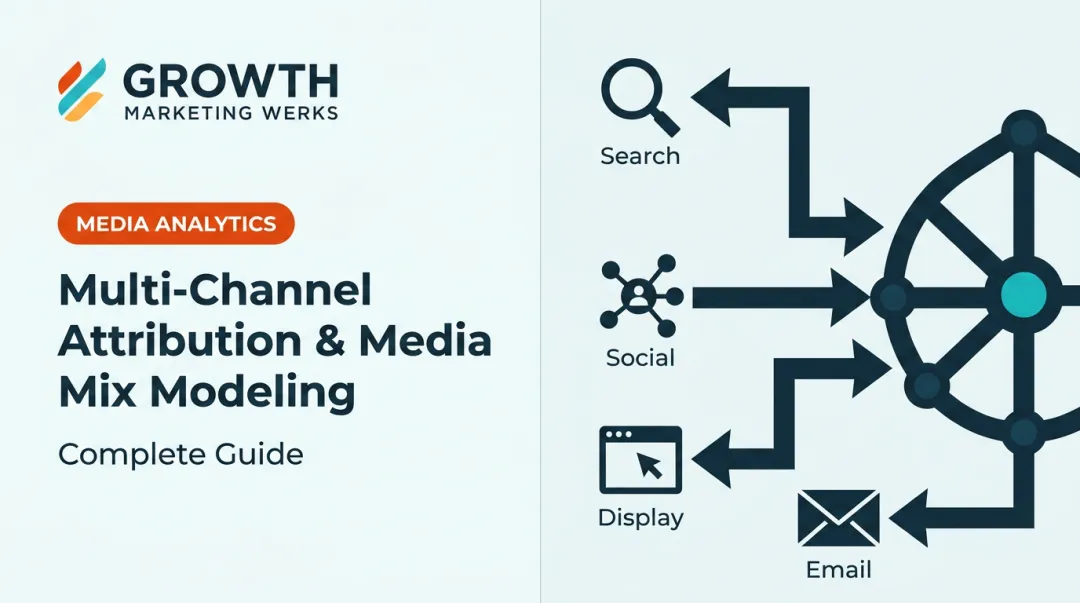
When a prospect converts after seeing a CTV ad, a retargeting display ad, and an email, who gets credit?
Attribution models handle this differently:
- Last-click: Gives all credit to the final touchpoint before conversion. Simple, but ignores everything that built the relationship
- First-click: Credits the initial interaction. Useful for acquisition analysis, but undervalues later-stage nurture
- Linear: Spreads credit equally across all touchpoints. Avoids single-touch bias, but treats all interactions as equally influential
- Data-driven: Uses account-level data to calculate each touchpoint's actual contribution. Most accurate, but requires sufficient data volume

Note: Google has deprecated first-click, linear, time-decay, and position-based models in Google Ads and Google Analytics as of late 2023. Data-driven is now the recommended default.
Unified Data Infrastructure
The most common reporting failure in multi-channel campaigns is siloed analytics, each platform reporting its own numbers with no shared view of the full journey.
Growth Marketing Werks uses Datorama as its central data aggregation platform, pulling performance signals across paid search, social, programmatic, CTV, digital audio, traditional media, and direct publisher buys into a single reporting environment. This enables real-time budget reallocation, cross-channel frequency management, and pipeline attribution that siloed dashboards simply can't produce.
One retail client case illustrates why this matters. A campaign designed to drive in-store traffic also generated a significant surge in online sales, producing 8x ROAS on digital spend alone. That halo effect was only visible because the full media portfolio and e-commerce tracking were managed under one roof.
Optimization Cadence
With unified data in place, you can act on what it tells you. Structure your campaign reviews at three levels:
- Ongoing: Monitor targeting, creative, and placement performance continuously. Reallocate budget toward what's working before waiting for a scheduled review
- Monthly: Review channel-level performance against funnel-stage KPIs. Identify patterns across audience segments
- Quarterly: Formal strategic review, assessing channel mix, audience targeting, creative performance, and progress against business objectives. Adjust before the next planning cycle
Resist the impulse to pause underperforming channels immediately. Most integrated campaigns need 60–90 days of stable data before drawing conclusions. Frequent changes disrupt the algorithmic learning curves that improve targeting efficiency over time.
Common Challenges in Integrated Media Planning
Budget Fragmentation Across Too Many Channels
Spreading a constrained budget across five or six channels guarantees underperformance on all of them. Nielsen's data puts the median underinvestment at 52% per channel, meaning most campaigns never give individual channels enough budget to reach their potential. Start with two or three channels, resource them properly, prove the model, then expand.
Inconsistent Messaging Across Teams or Vendors
Brands working with a PR firm, a social agency, and a paid media team often end up with three different stories running simultaneously. The solution is a master messaging document distributed to every partner, centralized creative assets, and a single lead coordinator, or a consolidated partner, accountable for narrative consistency.
Difficulty Proving Cross-Channel ROI
Nielsen's 2025 Annual Marketing Report found that only 32% of marketers measure media spending holistically across both digital and traditional channels, while 85% express confidence they're tracking ROI accurately. The gap between confidence and actual measurement is the primary reason cross-channel ROI remains elusive.
Practical fixes:
- Implement consistent UTM tagging across all digital placements
- Ensure pixel and conversion tracking are in place before campaigns launch
- Use a single data aggregation platform rather than platform-native dashboards
- Define "influenced revenue" alongside direct conversions so mid- and upper-funnel channels receive appropriate credit
Frequently Asked Questions
What are the key components of an integrated media strategy?
The five core components are: unified brand messaging, audience intelligence and segmentation, full-funnel channel alignment, cross-team coordination, and channel-specific KPIs tied to funnel stage. Each element depends on the others; missing any one typically produces inconsistent results.
What is the difference between integrated media strategy and multi-channel marketing?
Multi-channel marketing means your brand is present on multiple platforms. Integrated media strategy means those platforms are deliberately coordinated, sharing audience logic, consistent messaging, and funnel-stage assignments that make each channel reinforce the others rather than operate independently.
How do you measure the success of an integrated media campaign?
Success is measured through channel-specific KPIs tied to funnel stage: reach and brand lift for awareness, CTR and MQLs for mid-funnel, and ROAS or revenue conversion for lower funnel. Unified attribution reporting and progress against the overarching business objective, including leads generated, pipeline influenced, or awareness lift, complete the picture.
How much budget do you need to run an integrated media strategy?
Integration is a strategic approach, not a budget level. Brands can start with two or three channels, including owned and earned media, and run an effective strategy. Kantar found campaigns can be 2.6x more effective with optimal media allocation, even without increasing total spend.
What are the biggest challenges of integrated media planning?
Cross-channel attribution complexity, maintaining message consistency across teams and vendors, and spreading budget too thin across too many channels. These challenges are best addressed through a clear strategic framework, consolidated media management, and unified reporting infrastructure.
How often does an integrated media strategy need review and updated?
Tactical optimization runs continuously, with formal monthly performance reviews and a strategic review at least quarterly. A full annual wrap, assessing channel mix, audience shifts, and business outcome performance, is essential before the next planning cycle begins.