
Building a genuinely omnichannel plan sounds straightforward. In practice, results vary dramatically based on how channels are integrated, how data is unified, and how strategy is coordinated across the full funnel. According to Kantar's 2025 research, only 64% of marketers felt their campaigns were well-integrated, down from 89% in 2017. As media complexity increases, integration is getting harder, not easier.
This guide covers exactly what a truly omnichannel media plan requires: from foundational setup to step-by-step process, the variables that determine success, and the structural mistakes that derail even well-funded campaigns.
Key Takeaways
- Omnichannel is not the same as multichannel. Every channel must serve one unified customer journey, not operate in its own silo
- Audience understanding and journey mapping must come before any channel or budget decisions
- Unified data infrastructure and cross-channel attribution are non-negotiable
- Budget allocation covers the whole campaign portfolio, balanced across funnel stages rather than divided by channel
- Most omnichannel failures are structural problems, not budget problems
What Makes a Media Plan Truly Omnichannel
There's a meaningful difference between multichannel and omnichannel, and conflating the two is the root cause of most integration failures.
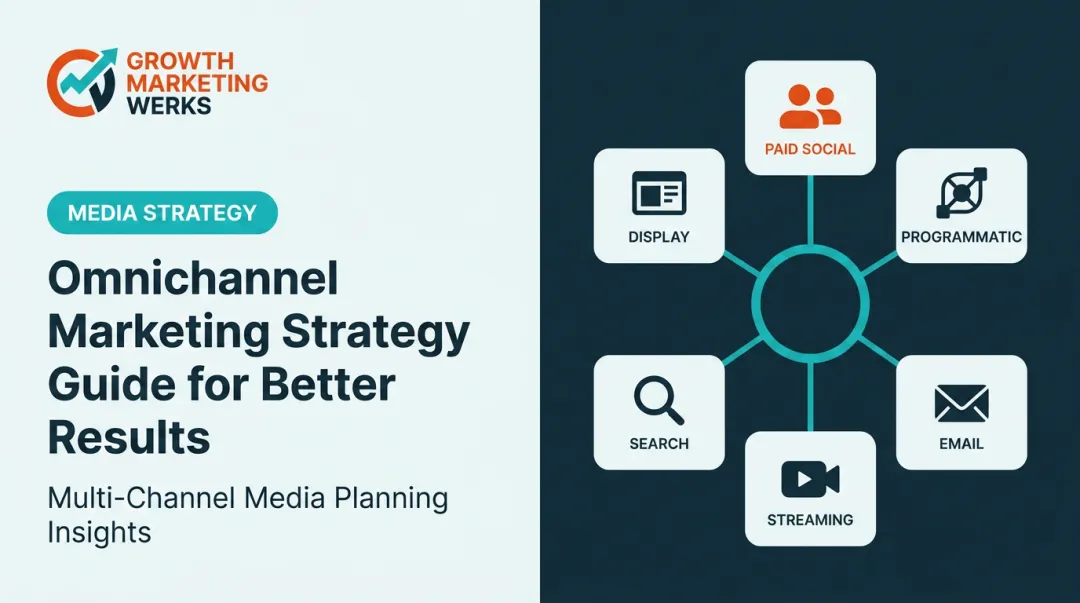
Multichannel means showing up on multiple platforms. Omnichannel means those platforms are strategically integrated so each touchpoint builds on the last, delivering a consistent brand experience regardless of where a customer encounters you.
Why Siloed Planning Persists
The structural reason integration is difficult: each media channel operates in its own measurement currency.
- TV is bought in spots and measured by GRPs
- Digital display is priced by CPM and evaluated by impressions
- OOH is measured by traffic and board equivalencies
- Social is optimized for engagements and follower growth
- Search is evaluated by clicks and conversion rate
Most planning tools, and most internal teams, are built around one channel type. Genuine cross-channel integration requires overriding those native incentives with a shared framework, which most organizations never build.
The Standard for "Truly Omnichannel"
A genuinely integrated plan has five characteristics:
- Single unified strategy that functions as one plan, not a rollup of separate channel reports
- Shared audience definitions so the same person is recognized consistently across every channel
- Consistent messaging architecture, a brand narrative that adapts to format but never fractures
- Full-funnel budget framework with investment allocated by funnel stage, not channel habit
- Cross-channel performance measurement giving you one view of how all channels contribute to outcomes

If your plan lacks any of these, it's multichannel, not omnichannel. Growth Marketing Werks uses these same criteria when auditing client campaigns, treating audience over-saturation, wasted spend on disconnected efforts, and a fragmented customer experience as the three diagnostic signs that a plan hasn't achieved true integration.
How to Create a Truly Omnichannel Media Plan
Step 1: Define Your Audience and Map the Customer Journey
Before any channel is selected or dollar allocated, you need to understand who your buyer is and how they actually move toward a decision.
Build audience personas that go beyond demographics. Include behavioral data: which channels they use, at what time of day, and for what purpose (research vs. entertainment vs. purchase). Growth Marketing Werks uses a combination of first-party CRM data, behavioral targeting, lookalike modeling, and research tools like MRI, Nielsen, and Comscore to build this picture for clients.
The channel complexity involved is significant. McKinsey's 2024 research found that business customers now use an average of 10 interaction channels during the buying journey, up from 5 in 2016. B2C journeys are similarly distributed across search, social, video, email, and in-store touchpoints.
Map the full customer journey from first awareness to conversion and post-purchase. At each stage, identify:
- What the customer needs (information, proof, reassurance, a next step)
- Which channels are present at that stage
- Where gaps or friction points exist between channels
A common gap: a customer sees a social ad on mobile, clicks through to a landing page optimized for desktop, and abandons. That's not a creative problem. It's a journey mapping failure that shows up in conversion data.
Step 2: Set Unified Goals and Cross-Channel KPIs
Channel-native metrics, including GRPs, likes, impressions, and clicks, are activity signals, not business outcomes. Optimizing for them in isolation means each channel looks successful while the overall campaign underperforms.
Establish goals that span the full funnel:
- Awareness stage: Reach, frequency, unaided brand recall
- Consideration stage: Engagement rate, time on site, content consumption
- Conversion stage: MQLs, SQLs, cost per lead, return on ad spend (ROAS)
Then identify one primary business outcome, including leads, revenue, or enrollment inquiries, and work backward. Each channel has a defined contribution to that outcome, creating a chain of accountability from impression to result.
Growth Marketing Werks structures this through media briefs that capture expected KPIs upfront, with both parties aligned before launch. A mismatch, like a "Buy Now" CTA paired with an awareness objective, gets flagged and corrected before it becomes expensive.
Step 3: Select Channels and Allocate Budget Across the Full Funnel
Channel selection is driven by where your audience actually spends time during each phase of their journey, not by what's easiest to buy or what performed well in a previous siloed campaign.
Consider the full channel spectrum based on your audience profile:
| Funnel Stage | Channel Examples |
|---|---|
| Awareness | CTV, broadcast TV, OOH, programmatic display, digital audio |
| Consideration | Native advertising, content syndication, social video, publisher-direct |
| Conversion | Paid search, social retargeting, ABM, email |

Allocate budget using a portfolio mindset. Gartner's 2026 marketing survey found that awareness and conversion together accounted for 62.6% of total media spend, while loyalty and retention dropped below 15%, a 29% decline since 2024. That imbalance reflects the industry's conversion bias, which hollows out mid-funnel investment over time.
The IPA's analysis of 40 years of effectiveness data points to a different equilibrium: just over 60% on brand building and under 40% on activation produces optimal long-term business outcomes.
Growth Marketing Werks approaches this explicitly as one portfolio of campaigns across every channel and division, diversifying channel risk, balancing reach against conversion activity, and resisting the temptation to concentrate spend in "proven" channels at the expense of full-funnel coverage. Their Enstrom Candies engagement illustrates the model in practice: a portfolio strategy across wholesale, direct-to-consumer, Amazon, and retail simultaneously delivered 3x ROAS and 25% of revenue attributed directly to ad-supported conversions.
Step 4: Develop Consistent Creative With Channel-Specific Adaptations
Budget allocation only pays off if the creative holds together across channels. When teams adapt assets independently, the brand ends up looking and sounding different at each touchpoint. That inconsistency creates friction for buyers and erodes the cumulative effect of media investment.
The right sequence:
- Define the master brand narrative and messaging hierarchy first, including core value proposition, supporting messages, tone, and visual identity system
- Then adapt these components to fit each channel's format and context
- Never let format adaptation override thematic coherence
Design for message sequencing, not message repetition. A consumer encountering your brand on CTV for the first time needs a different message than one who has already engaged with your content on social media. The CTV message builds awareness; the social message deepens consideration. Showing the same awareness ad to someone already in the consideration phase wastes frequency and misses a conversion opportunity.
Growth Marketing Werks applies this directly: CEO Suzanne Corriell describes the standard as "everything has to tell the same story, brief, creative, and landing page." The Trimble campaign illustrates what this looks like at scale: a consistent content strategy across print, digital display, and email simultaneously produced a 44% improvement in average session duration, confirming that message consistency compounds over time.
Step 5: Unify Your Data Infrastructure and Reporting
Without unified data, you're running a multichannel plan. What makes it truly omnichannel is the operational infrastructure to connect those channels, including shared reporting, cross-channel attribution, and a single view of performance.
Implement a data aggregation platform that consolidates performance data from all channels, digital and traditional, into a single view. Growth Marketing Werks uses Datorama for this purpose across client campaigns, connecting disparate channel data into one reporting environment rather than requiring teams to toggle between disconnected dashboards.
Replace last-click attribution with a multi-touch model. Last-click attribution is still the dominant measurement method. eMarketer found that 78.4% of marketers use last-click or web analytics to measure media efficacy, yet only 21.5% of those marketers believed it reasonably reflected a platform's long-term business impact.

The consequence is predictable: last-click makes paid search look like the hero of every campaign and makes CTV, display, and social look like waste, even when those channels generated the consideration that made the search click possible. The Enstrom campaign at Growth Marketing Werks showed this clearly: a campaign built to drive in-store traffic unexpectedly also drove online sales, delivering 8x ROAS on digital spend alone. That result was only visible because the full media portfolio was managed with integrated tracking in place.
Key Variables That Affect Omnichannel Performance
Even well-constructed omnichannel plans produce different results depending on how these variables are managed. Neglecting any one of them can undermine the entire strategy.
Budget Allocation and Portfolio Balance
Concentrating too much spend in one channel, even a high-performing one, creates funnel imbalances. Audiences get over-exposed at one stage and never moved to the next.
Kantar's CrossMedia analysis shows campaigns could be 2.6x more effective with the right media spend allocation. Meanwhile, Nielsen's 2024 Annual Marketing Report found that 70% of marketers planned to increase performance marketing spend at the expense of brand building, a shift Nielsen warns can cause long-term brand decay.
Impact of imbalanced allocation:
- Strong awareness with no conversion path
- Strong conversion activity with depleting demand at the top of the funnel
- Long-term ROI erosion as fewer new prospects enter the pipeline
Audience Data Quality and Identity Resolution
Omnichannel execution depends on recognizing the same person across devices and platforms. Poor audience data means you're serving disconnected messages to people you can't connect across touchpoints.
Three areas demand attention here:
- First-party data activation: building audiences from your own customer data rather than borrowed signals
- Identity matching: deterministic methods (login-based) are more accurate; probabilistic methods (device inference) carry more error
- Data clean rooms: privacy-safe environments for collaborating on audience data across platforms without exposing raw records

IAB's 2024 State of Data report found that 71% of brands and agencies were expanding their first-party datasets, a direct response to signal loss from privacy changes that have made third-party identity resolution less reliable.
Impact of weak identity resolution:
- Same person sees the same awareness ad 15 times (frequency waste)
- No retargeting or message progression occurs (journey stalls)
- Budget appears to reach a large audience but delivers fragmented experiences
Attribution Model Selection
Attribution model choice directly shapes budget decisions. A last-click model makes paid search look dominant and makes CTV, display, and social look expendable, even though those channels drove the consideration that made the search click possible.
This is a structural budget problem disguised as a measurement preference. Teams that rely on last-click chronically underinvest in awareness and mid-funnel channels, and when the demand pipeline thins out, the conversion channels that looked so efficient have nothing left to convert.
Impact of last-click attribution:
- Upper-funnel channels lose budget despite driving downstream results
- Paid search appears more efficient than it actually is
- Pipeline gradually depletes as fewer new prospects are nurtured into consideration
Creative Consistency and Message Sequencing
Measurement tells you where to spend. Creative determines whether that spend actually moves people. Fragmented creative, where tone, offer, or visual identity differs across channels, creates confusion for buyers and erodes brand trust. Identical creative that ignores channel context has the opposite problem: it fails to engage.
The goal is a unified narrative expressed in contextually appropriate formats. When creative coordination breaks down, a campaign can have solid targeting and the right budget allocation and still underperform, because the message itself never built coherent momentum across the journey.
Common Mistakes That Derail Omnichannel Media Plans
Presence isn't integration. Being active on six platforms means nothing if each one runs its own strategy, creative, and goals. True omnichannel requires one unified strategy expressed across channels, not six mini-campaigns running in parallel.
Side-by-side channel reports aren't unified measurement. If you can't trace how a customer moved from a video impression to a social engagement to a search click to a conversion, you have a spreadsheet, not cross-channel visibility.
Over-indexing on conversion channels starves the top of the funnel. Search and retargeting deliver clear, attributable results, so brands pile spend there and pull back from awareness and consideration channels. The result is a demand deficit that shrinks the pool of prospects entering the funnel to begin with.
Choosing channels before mapping the customer journey. Picking platforms first, before understanding where your audience is and what they need at each stage, builds a plan around media habit, not strategy.
Conclusion
Creating a truly omnichannel media plan means treating each channel not as a standalone investment but as one element in a coordinated system, where audience data, creative messaging, budget allocation, and performance measurement all work together to move the same person through a deliberate journey.
Most omnichannel failures aren't budget problems. They're structural: siloed planning and disconnected data that signal to buyers the left hand doesn't know what the right hand is doing. Brands that run media as one full-funnel portfolio of campaigns, rather than a collection of separate ad buys, outperform those that don't.
If you're ready to build a media plan that's genuinely integrated from strategy through measurement, Growth Marketing Werks works as a strategy-first media expert, not an order-taker, to help mission-driven organizations get there. Our flat-fee model means the only incentive is your growth, not your media investment.
Frequently Asked Questions
What is omnichannel media planning?
Omnichannel media planning is the practice of building a single, unified media strategy that integrates all channels, digital and traditional, so every touchpoint works in coordination to deliver a consistent customer experience. It's distinct from simply running ads on multiple platforms, which is multichannel, not omnichannel.
What are the main components of an omnichannel media planning strategy?
Four components form the foundation of an omnichannel media plan:
- A unified audience definition and customer journey map
- A cross-channel budget framework aligned to funnel stages
- Consistent creative architecture with channel-specific adaptations
- A centralized data and attribution system that measures performance across all channels
What is an example of an omnichannel media planning approach?
A brand runs CTV ads for broad awareness, retargets engaged viewers with social ads that deepen consideration, and captures active researchers through paid search, measured through a unified attribution model that credits each touchpoint's role in the conversion, rather than awarding all credit to the final touchpoint.
How is omnichannel media planning different from multichannel media planning?
Multichannel means a brand has a presence on multiple platforms. Omnichannel means those platforms are deliberately integrated, sharing audience data, consistent messaging, and unified measurement, so the customer experience is coherent across all of them rather than fragmented.
Which KPIs to track in an omnichannel media plan?
Track KPIs at each funnel stage: reach and frequency at awareness, engagement and site behavior at consideration, and conversions or pipeline metrics at the conversion stage. Layer in a cross-channel attribution metric, such as assisted conversions or multi-touch revenue attribution, to show how channels contribute together.
How do I know if my current media plan is truly omnichannel?
A simple test: if each channel has its own goals, creative briefs, reporting dashboard, and no shared audience data, your plan is multichannel, not omnichannel. A truly integrated plan is reflected in unified strategy documentation, shared KPI hierarchies, and a single cross-channel reporting view.