
Introduction
Your paid media budget is probably spread across seven or eight channels right now. Google, Meta, LinkedIn, programmatic display, maybe some CTV, maybe still some print or radio. Each platform reports its own version of success, and none of those numbers agree with each other.
Better dashboards won't fix this. The real issue is measurement: none of your platforms speak the same language when it comes to results.
Media models are the analytical frameworks (Media Mix Modeling, attribution, incrementality testing) that connect what you spend to what actually happens in your business: sales, leads, revenue. Without one, you're guessing which channels deserve more budget and which ones are wasting it.
This article breaks down the three major media models, how they differ, and how to pick the right one (or combination) for your paid media strategy.
Key Takeaways
- Media models measure how paid media investment actually drives sales, leads, or revenue
- Three core types exist: Media Mix Modeling, Multi-Touch Attribution, and Incrementality Testing
- No single model fits every brand: the right pick depends on channel mix and data maturity
- Mature strategies combine models rather than betting everything on one
- A skilled strategy-first media expert turns model outputs into a diversified, defensible media portfolio
What Is a Media Model?
A media model is a statistical or experimental framework that quantifies how your paid media channels, along with outside factors like seasonality or promotions, influence business outcomes. It's the translation layer between "we spent $50,000 on LinkedIn" and "here's what that spend actually generated."
Why do you need one at all? Because in-platform metrics lie to you, sometimes without meaning to. Every platform's self-reported ROAS assumes its own touchpoints deserve full credit. Layer on privacy shifts like cookie deprecation and Apple's App Tracking Transparency requirements, and self-reported numbers get shakier by the year.
The evidence backs this up. In IAB's 2024 State of Data survey, 73% of U.S. advertising decision-makers expected privacy legislation and signal loss to keep reducing their ability to attribute performance and track conversions accurately.
A few quick clarifications:
- Media models are planning tools for everyday budget decisions, not academic exercises reserved for data scientists
- "Media model" and "marketing mix model" often get used interchangeably in everyday conversation
- Technically, a media model focuses on promotional and media channels specifically, while a full marketing mix model also accounts for price, product, and place
Why Media Models Matter for Paid Media Strategy
Without a model connecting spend to outcomes, marketers default to gut feel or last-touch data. That combination tends to overfund whatever channel gets the final click and starve the channels doing real work earlier in the journey.
The cost of that guesswork is real. A Forrester Consulting survey of 409 U.S. marketing decision-makers found respondents estimated that 21 cents of every media dollar had been wasted due to poor data quality.
Beyond the waste itself, media models give you something a gut feeling never will: defensible evidence you can bring to finance or the C-suite.
That principle shapes how Growth Marketing Werks operates: we treat every ad dollar as a capital allocation decision, weighing risk across channels and prioritizing measurable returns over vanity metrics. Allocation across the campaign portfolio shifts as markets do.
In practice, that's translated into recommending brand awareness studies for a client like Pinnacol Assurance to turn media metrics into boardroom-relevant business impact. With TalentReef, three years of incremental wins (+85% MQLs, +141% SQLs, +179% ARR bookings) progressively unlocked larger budgets, expanding the relationship from one vertical campaign into a full ABM strategy.

Data-backed models don't just optimize campaigns. They change the conversation you're having with leadership.
Types of Media Models
Media models range from top-down statistical estimates to bottom-up, user-level tracking to controlled real-world experiments. None of them work identically, and sophisticated paid media strategies rarely rely on just one.
The right blend depends on the question you're asking: budget allocation, tactical optimization, or proving a channel actually works.
Media Mix Modeling (MMM)
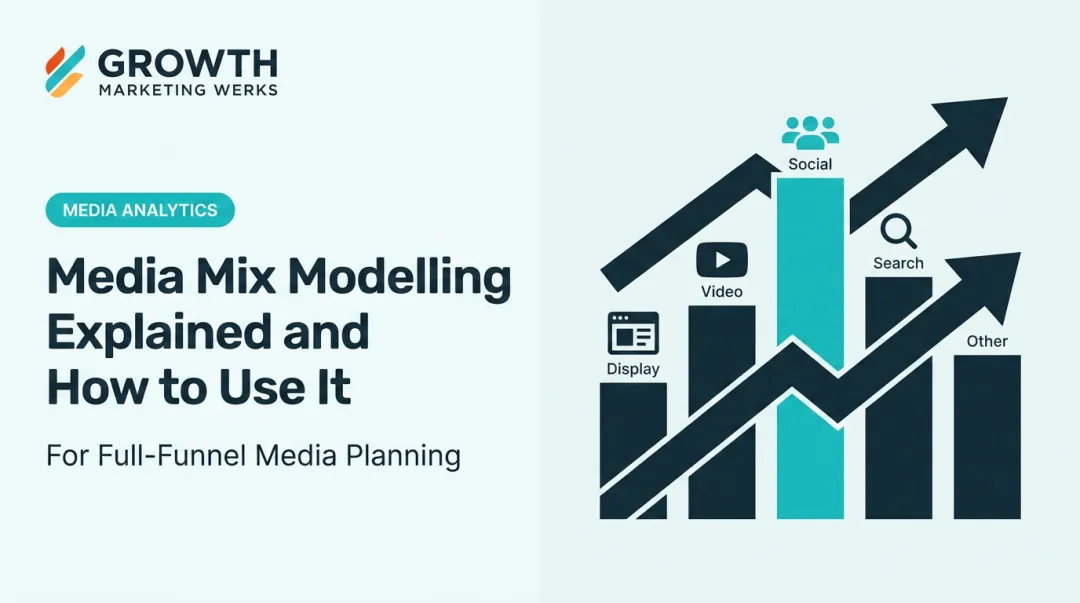
MMM is a top-down statistical technique. It uses aggregated historical data and regression analysis to estimate how much each channel contributed to sales or revenue. Layering in external factors like seasonality, promotions, and economic conditions isolates each channel's true, incremental impact, including where diminishing returns kick in.
What sets it apart: MMM uses privacy-safe, aggregate data rather than tracking individual users, and it evaluates long-term, cross-channel impact instead of touchpoint-by-touchpoint detail.
Best suited for: Brands with omnichannel spend, including offline and TV, making quarterly or annual budget allocation decisions.
Key strengths:
- Privacy-resilient by design, since it doesn't rely on cookies or device IDs
- Accounts for offline channels and external market factors
- Strong for high-level budget planning and scenario forecasting
Limitations:
- Needs a lot of runway: Meta's own Robyn guidance recommends at least two years of weekly data, or four to five years if you only have monthly figures
- Produces infrequent insights, not real-time feedback
- Risks overfitting if not validated carefully
Multi-Touch Attribution (Data-Driven Attribution)
MTA flips the approach. It's a bottom-up model that tracks individual user touchpoints across the digital journey (clicks, impressions, sessions) and uses algorithms to weight each interaction's influence on the eventual conversion.
The difference from MMM is granularity and speed. MTA gives you near real-time, touchpoint-level detail; MMM gives you the long view.
Best suited for: Digital-heavy brands optimizing day-to-day campaign performance, creative testing, and audience targeting within known digital channels.
Key strengths:
- Fast feedback loops that support in-flight budget shifts
- Granular, campaign-level optimization
Limitations:
- Little to no visibility into offline conversions
- Increasingly hampered by cookie deprecation and walled-garden restrictions
- Tends to overweight last-touch channels, undervaluing upper-funnel work
Incrementality Testing
Incrementality testing is different from both. It's an experiment, not a statistical estimate, using geo holdout tests and audience split tests to measure the true causal lift a channel generates by withholding exposure from a control group and comparing outcomes.
That's the key distinction: incrementality relies on real-world experimentation, making it the most direct way to prove causality rather than infer it.
Best suited for: Validating or calibrating MMM and attribution outputs, testing a new channel before scaling spend, or settling internal debates about whether a channel is actually pulling its weight.
Key strengths:
- The clearest causal proof of channel value available
- Works even with limited historical data
Limitations:
- Time- and resource-intensive to run properly
- Needs enough scale or geographic spread for statistical significance
- Only tests one variable at a time

In practice, blending these models reveals insights a single approach would miss. When we worked with Enstrom Candies, a campaign built to drive in-store traffic turned out to also be generating online sales: an 8x ROAS on digital spend that a single-channel view would've completely missed. Layering retail and digital-attributed revenue together produced a 3.5x blended ROAS, reflecting the campaign's true impact rather than a partial view.
How to Choose the Right Media Model for Your Paid Media Strategy
The right model depends on the business question you're trying to answer, not on whichever approach is trending in marketing podcasts this quarter.
Weigh these factors before committing:
- Purpose and goals: Are you allocating strategic budget, optimizing tactically, or validating a channel's worth?
- Data maturity: How much clean historical spend and outcome data do you actually have across channels?
- Channel mix: Omnichannel or offline-heavy portfolios lean toward MMM; digital-only portfolios can lean more on attribution
- Budget and resources: Larger budgets can support running multiple models simultaneously. Smaller budgets often call for one lighter-weight approach instead.
- Speed of decision-making needed: Real-time optimization calls for attribution; quarterly planning cycles suit MMM
At Growth Marketing Werks, we build media plans and measurement stacks (including Datorama-powered reporting) tailored to each client's actual data maturity and full-funnel goals. Because we run on flat-fee pricing rather than commission, there's no incentive to push you toward the most expensive model when a simpler one answers the question just as well.
What to Check Before Finalizing Your Approach
Before you lock in a measurement approach, run through this checklist:
- Don't over-buy. Skip enterprise-grade MMM if a lighter attribution setup or a single incrementality test would answer your question just as well
- Don't ignore known limitations. Relying solely on last-click attribution, or building MMM on 6 months of patchy data, will give you confident-sounding, wrong answers
- Budget for maintenance. Every model needs ongoing refreshes and clean data feeds. Factor that cost in upfront, not after you've committed
- Let your channel mix and goals drive the decision, not whichever model a vendor happens to be selling that quarter

Conclusion
Media models turn scattered, contradictory paid media data into a clear picture of what's actually driving results. MMM handles strategic allocation, multi-touch attribution manages tactical, in-flight optimization, and incrementality testing proves causality when the stakes are too high to guess.
Strong paid media strategies rarely pick just one. They use them together, at the right moments, for the right questions.
Understanding these differences is the first step. Pairing that understanding with an experienced media advisory partner, like Growth Marketing Werks, turns it into smarter budget decisions and better long-term ROI.
Frequently Asked Questions
What are media models?
Media models are analytical frameworks, including Media Mix Modeling, attribution, and incrementality testing, used to measure how paid media investment drives outcomes like sales, leads, or revenue. They replace guesswork with evidence.
What's the difference between media mix modeling and multi-touch attribution?
MMM is a top-down, aggregate approach best suited for long-term, strategic budget planning. MTA is bottom-up and user-level, built for optimizing digital campaigns in near real-time.
How much historical data do I need to build an accurate media model?
MMM typically needs at least two years of clean weekly data (or four to five years of monthly data). Attribution and incrementality testing can generate useful insights much sooner.
Can incrementality testing replace media mix modeling?
No, they're complementary. Incrementality tests validate and calibrate MMM's assumptions rather than replacing its broader, strategic view of your channel mix.
How often does a media model need updating?
MMM is usually refreshed quarterly or annually. Attribution updates continuously as new data flows in. Incrementality tests typically run periodically to validate assumptions as needed.
Is media modeling only for large enterprise brands?
No. Advanced MMM does suit larger budgets, but smaller brands can still use lightweight attribution or targeted testing, especially when working with an experienced media advisory partner.